

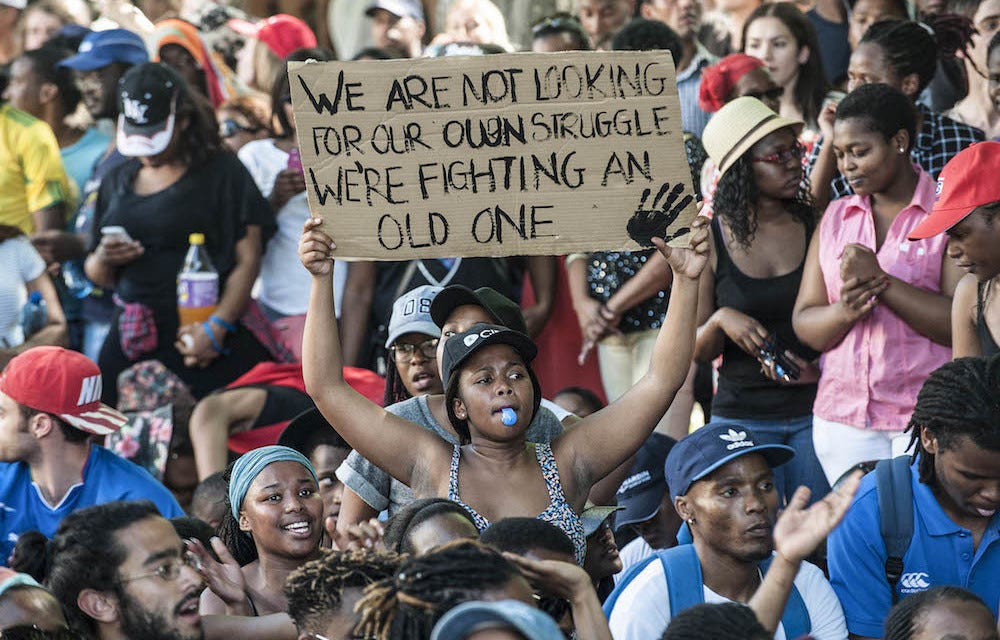
It recently dawned on me that the default setting of young South Africans is anger. Anger at a system, at the past and how it mistook the stories of victors and victims and that government at large. Yet not of this anger actually encourages activism, institution building and pragmatic approach to the future. Most crucially, inability to implement the lessons of the past and act on them in the current day.
Watching an episode of the Winnie Mandela documentary, it highlights the moment when the late Winnie Madikizela‑Mandela was moved to Brandfort, now renamed Winnie Mandela. During her banning order she continued to enact her activism even when the government tried to suppress her.
While she was living out her banishment she established a local gardening collective, a soup kitchen, a mobile health unit, a day care centre, an organisation for orphans and juvenile delinquents, and a sewing club. She was unwilling to be stopped by the obstacles placed in front and was fearless in the face of the state that was prosecuting her, her family and her husband.
Applying the same fearless trope that was established by Ms Madikizela‑Mandela simply does not reflect in the same capacity in the youth. At the moment the majority of the conversation is dominated online in space where people are inclined to agree with each other and establish a voice they trust and deem legitimate, while the algorithm and personal bias do away with the rest. The discussion never moves beyond the publish button.
There have been countless articles where individuals pour their emotions and heart out into how “systems” influence the reality they have experienced and shaped. But there is never clarity to what those systems are or how broadly applicable that reality is beyond the like button, but even then it does nothing to change the communities that are being spoken about.
In a moment when Ms Madikizela‑Mandela was banished to a place 400 km away from Johannesburg, beyond talking about the problems she faced, she actively took to doing something about them. The publicity and the interviews contributed to people being aware of the community and contributing to her overall projects. Her recognition was not self‑sustained; it led to development for a community that had suffered under the segregation laws of apartheid.
Further, she spoke truth to power; she continued to walk through the front door when it was assigned for whites only and she went to whites‑only supermarkets. She was not loud about it, but had the humility to recognise the moment and the pride to know who she was and the importance of maintaining her dignity.
Currently, perception seems to be the driving force for people’s desire to be active in society. Questions about whether or not individuals are deemed performative for sharing their expression on particular topics and outlooks—particularly those concerning them the most closely—have meant that the pursuit of writing is self‑interested. To some degree there is truth to that.
All writers who contribute to society have a degree of prestige in society and influence. Depending on how valuable their insights, experience and established legitimacy are, they are rewarded with various access to different people, spaces and awards that are not paid to the common man. To some degree it reflects the same reality of politics, but done more subtly.
These writers are self‑interested; however, it does not negate their desire to influence discourse and have a positive impact on society. They have a desire to see the problems that they speak about eradicated, they have desires to ensure that their experience is shared and made knowable to a wider and diverse audience, and they hope to see change. But the question the reader is constantly asked is how?
Firstly, where the reality struck many of us young people is that many of us simply just do not know the answer to that—purely for the fact that most of the time we are underqualified, unqualified and to a great degree still figuring things out.
The authority and the absoluteness that is fully expressed and allowed in opinion does not always align with the reality and the data and statistics. But further beyond that, the technicalities, the complexities of bureaucracy and the overall inability to appreciate the scale of the issue makes the answer much further than it seems.
This is true of most of the problems that face South Africa, whether it be emigration, unemployment, gender‑based violence, xenophobia, education, literacy, inequality or any other problem that plagues the average South African on a daily basis. There simply would be no easy answer.
Sometimes the few words that are shared on platforms online are devoid of the research and the data necessary to make the aspiration a materialised reality. But beyond that it is unwillingness to take the step to act which is the second problem.
History is written retrospectively; the story is told in a manner that is made to make sense, made to fit the timeline—however, the reality is far from that. Malcolm Gladwell has spent time speaking to this in both his book Revenge of the Tipping Point and Tipping Point. What is evidently apparent is that the first and most important thing is to act, to be the one to build the dream and develop the society that you aspire to see.
This is where the harsh reality for young South Africans comes in: for those who do have the desire for this country there is not always willingness to sacrifice. To give up the lifestyle, the security and the potential of pension to develop the dream. To beyond influence be the first to take action and chart the way for other South Africans to follow suit.
Ms Madikizela‑Mandela could not have known how history would have spoken of that moment. To have known that she revolutionised a town and became a vital community member who was acting first for her community, her kids and then herself when everything was framed against her. She could have never known it was a moment touted as being part of the progression of liberation, a moment when the government showed full frustration with her and her activism after the 1976 Soweto Uprising and when she showed she refused to be contained. Instead of looking back she decided to move forward.
Currently that is what is needed most in South Africa. There has been so much discussion about the past, uncovering of the past and dissection of the past that it feels as though there is an inability to agree about the past. Instead of investing that time in planning the future, discussing ways to objectively evaluate the situation while acting at the same time to ensure there is no further lag or bureaucracy that delays progress. The desire to act drives all then maybe the activism will be worth something and framed as being more than performative.
Maybe it will move beyond the frame of likes and clicks and establish itself in meals, community reading classes and political classes for people in communities—where people go to share their knowledge and expand the number of people who can contribute to the discourse.
More importantly, to come face to face with the reality of how many South Africans do not intellectualise their problems and are faced with their reality and survival on a daily basis. There is no time to be angry at the framing of the past when there is suffering present now and an inability to resolve it in the future.
Worse still, when the education, sports and recreation and cultural institutions continue to be bloated and deny access to social mobility, leaving children in vulnerable situations and realities too dark to give light. There will be realisation that it needs to be a conversation with outcomes; if not, it is no different to the same politicians and journalists that framed the past that everyone is so angry at.
So maybe when there is discussion about the past let it not be that it frames everything that informs the outlook of society today. It is important, it is valuable and is riddled with a multitude of lessons and messages. But what was most important was their action.
Winnie Madikizela‑Mandela, when banned from meeting more than one person at a time, decided to make her presence felt everywhere not in word but in action. Instead of complaining, leaving the solution for some outsourced more inspired and more fearless activist, she decided to be the one to show the world she could not be stopped and her community would not be limited by the state.
Hate her or love her, her legacy is one of action. One where the community knew of her presence, knew of her being but most importantly revered her actions, subtle or large. Even while attending court in Bloemfontein she wore the colours of the ANC because she exclaimed her right to her wardrobe. She never gave in and showed that even when there is conversation to be had there will forever be work to be done.
As we as young people continue to make sense of our anger, let it not be in a void that is left to the few elites who are privileged to know—to have access to a world of information, perspective, sources and thoughts. But simultaneously, let us not discredit the realities and the need to resolve problems based on priority. Sometimes what our history or politics of the day are may do nothing to resolve the generational suffering known to so many.
What I would hope we found is the desire to act, to use our privilege, social status and place in society and show we are willing to sacrifice it for those who have gone without for far longer. Or at least show that the gains of the privilege are at least shared with communities which are spotlighted and highlighted. To ensure their stories are not just a means of invoking anger but developing a better future.
The future is currently ours and will forever be ours until they tell the next generation it there. There is no better time than now to act and history will write its own story. Actions now do not need the words at present to have a true meaning down the line. But actions are just those actions that lead to something beautiful on the other end.
If Winnie Madikizela‑Mandela chose to act when the world made it impossible, what would it take for us to move beyond our anger and find the love necessary to change our current reality?
Amazing article. In the 80s and 90s AZASM medical students provided free winter school to matric student, providing tuition support for maths and science. They were following the spirit of Steve Biko.
When I started working in my early 20s, I was approached by a student who needed registration money. I was an administrator at a college. I gave her the money knowing she would be eligible for a bursary afterwards. I told her that if she performed badly in the first year she would have to lay back my money back.
Another one failed an aptitude test required to qualify for registration. She came to me crying. I negotiated with the departmental head to take her in. Again I told her that if she dared fail any subject she should be kicked out. All those students completed their qualifications with flying colours.
Am not beating my own drum. Am just demonstrating that there is always something you can do. Just think a little deeply.
Thank you Khumo Khumalo.