

“In the winter of 1983, two nine-year-old Brandfort boys had been playing outside her house. Her grandchild, who was staying with her at the time, accused the two boys of stealing her tricycle. Winnie stormed out of her house, took the leather belt off her waist, wrapped it around her fist, and struck one of the boys, Andrew Pogisho, her belt buckle opening a deep gash on his forehead. To Malefane’s shock, she kept hitting the boy with her buckle, despite the sight of a great deal of blood. He threw himself on her, and the two of them fought each other with their fists in the dust. Pogisho’s mother laid a charge of assault with the police, and Winnie stood trial later that year. The boy himself gave testimony in a closed hearing. Winnie contested his evidence, and neither Malefane nor the half - dozen or so neighbours who had witnessed the incident were called. She was acquitted.” An extract from the book Winnie and Nelson: Portrait of a Marriage by Jonny Steinberg.
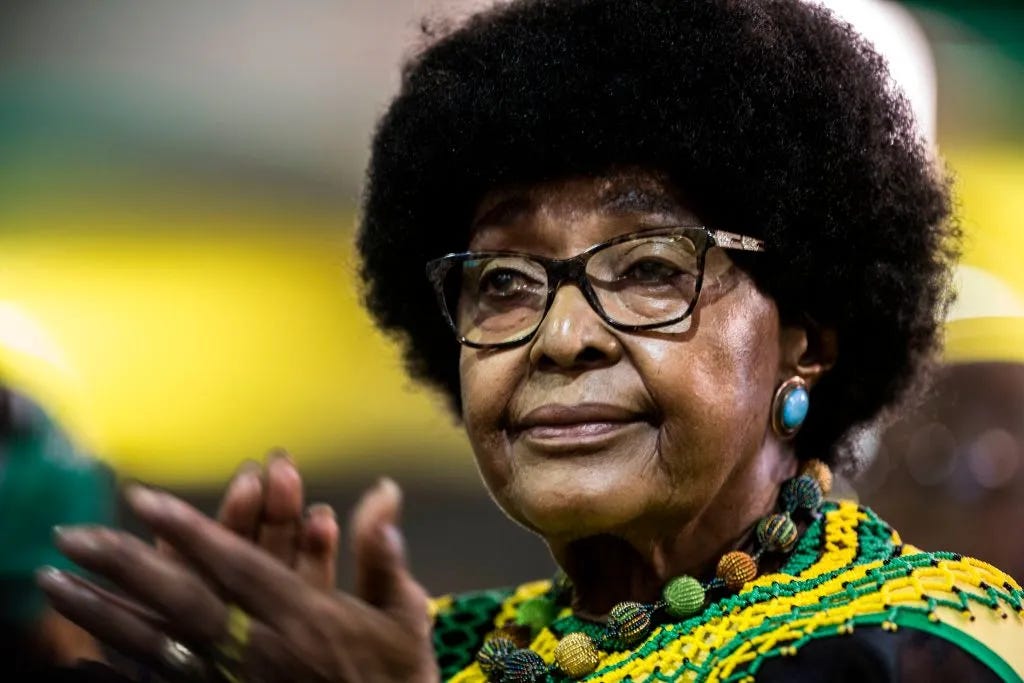
Winnie Mandela , for a number of South African women and youth, exists as a reverent figure. Not only in deep respect, inspiration, or glory, but in reliance too. There exists a need for a symbol for the communities in endless peril; navigating femicide, unemployment , and often the structural consequence of being born free but forgotten and ignored. The people need a God. There is a glorification of Pan-African leaders all the time, not just because of their rhetoric, but because they encapsulate the hopes and pains of their people as saviours. Their crucifixion at the hands of oppressive states and their calls for liberation and paradise are so sure and so fervent they are almost divine. The question then becomes: how do you hold them and their legacies accountable, especially when they leverage harm against the communities they claim to protect?
This piece is not aiming to claim Winnie is evil or invalidate her contribution to the struggle, and neither is it claiming that perhaps her actions are justified because of her suffering; all it seeks to do is simply explain her actions and dissect them in relation to her legacy.
One of the most interesting things evident in Orlando East during the 1980s and 1990s is the amount of machismo violence and violent virility. Unfortunately , reflective of this was Winnie Mandela’s “football club”.When the Soweto home of Winnie Mandela was burnt down, she tells Nelson it was likely the retaliation of police forces. This was not the case because it was a response from schoolchildren who were at odds with how members of her football club had allegedly assaulted a Soweto schoolgirl. Redi Tlabi describes living in Orlando East at the time in her memoir: “ It was not uncommon for a young woman to be walking down the street and for someone, even another woman, to point at her and snigger, ‘Phela, this one got raped by so-and-so.’ So-and-so would be a well-known thug still roaming the streets without a care in the world.” Winnie’s tribe of bandits not only failed to protect local women but arguably bolstered the violence already rife. Beyond this alleged violence was a broader definitive harm leveraged. “Quite how much was at stake for those young men who refused the football team’s approach soon became apparent. On May 26, 1987, two brothers, Peter and Phillip Makhanda, were taken forcibly from their home, driven to
Winnie’s place, and put in an outhouse on the property. They were severely beaten. One of them, Peter, was hung by the neck from the roof until the rafters broke and he fell to the ground. A plastic bag was pulled over his face and his head dunked in a bucket of water, an imitation of one of those apartheid security police’s most familiar methods of torture. Then the carving began. The boys were placed on chairs and their hands tied behind their backs. Using a penknife, a member of the football team cut the letter “M” for Mandela into their chests and “Viva ANC” down the lengths of their thighs. The wounds were then doused with battery acid.” Another extract from the book Winnie and Nelson: Portrait of a Marriage by Jonny Steinberg. Not snitches or informants, just young Black men who refused to join the cult of violence that Winnie sponsored. There are some supporters in the most ardent of Winnie’s camp that seek to differentiate her actions and character from that of her “football club,” but that’s without logic. Winnie was likely cognisant of the structure’s actions, and at numerous times, she did not find it problematic. For example, when UDF leader Dudu Chili was concerned that Winnie’s football club was going to murder her son, she approached Winnie, and her reply, as Dudu Chili recalls, was condoning in nature. “Dudu, if he’s not in the football club, obviously the other boys will think he’s a sellout .” Winnie, years later in a democratic South Africa, describes to her private secretary that “Black people had made lives for themselves within the constraints of apartheid... they had to be more scared of me than of the apartheid regime if they were going to rise up.” She displayed a deep understanding of fear as a political apparatus, and was willing to have it utilised against innocents.
Her close association with men like Jerry Richardson, Johannes Mabotha, and Brian Somana who were all informants leaves a bitter taste in my mouth considering the necks burnt at her hands. Countless people of colour who met their end without trial, and sometimes without even valid suspicion, were sentenced to flames and purgatory by the person meant to save them. After the tears and ashes, there stands a legacy suddenly reformed. Devoid of uncomfortable truths. Reformed by the women and youths who need a God the most.
