

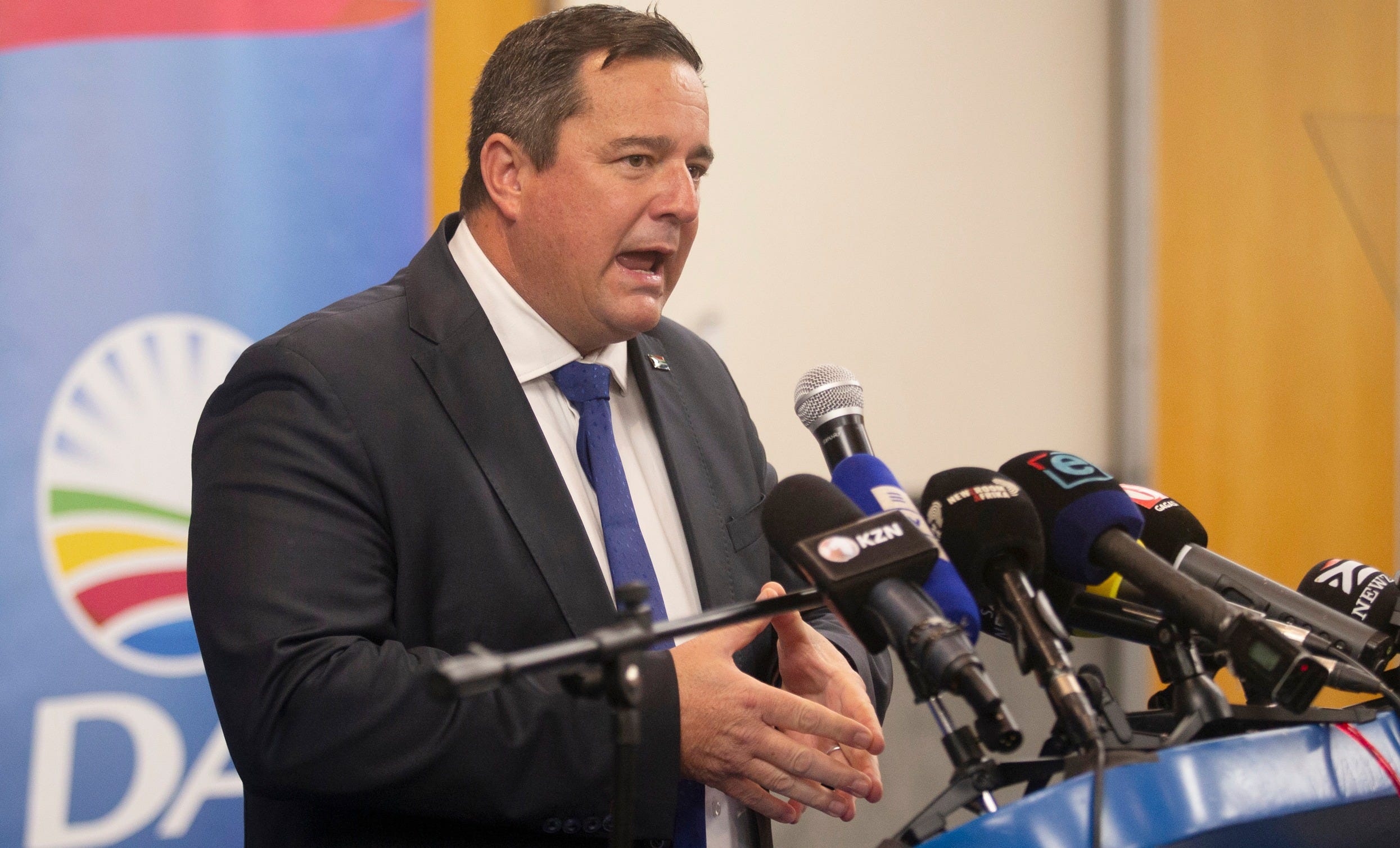
The announcement by Democratic Alliance Leader John Steenhuisen stating that he would not seek re-election for the position of DA Federal Leader marks an interesting turn in South African politics. More interestingly, it begins the early waves of the political drama that is about to unfold. But is this story of his exit being told slightly incorrectly, and is it a deeper reflection of what conservative South Africa’s view is on the country?
All around the media, the credit card scandal and the ousting of Dion George, finance chair and Minister of Forestry, Fisheries and the Environment, are framed as the catalyst for this decision. It is presented as a perfect story without a perfect ending: an individual mistake made by a politician that results in a personal decision over a political one. This marked the beginning of media leaks from both Dion George and John Steenhuisen, resulting in George’s resignation after the investigation findings.
The findings cleared John Steenhuisen of wrongdoing in the credit card expenditures; he remains under inquiry over allegations that he brought the party into disrepute. There was not much beyond reputational damage, which fell heavily on Steenhuisen, and an emulation of politics seen in the ANC with media leaks and calculated oustings.
However, in reality, no crime had been committed. No evidence had been found and nothing was to be disputed. Steenhuisen’s reason to leave, though potentially actioned now, was not actioned now by any stretch of the imagination.
Steenhuisen’s media run upon announcing his option not to be re-elected has been interesting because within most of the discussion he has particularly emphasised that he has delivered on his promise and his duty.
He both led the DA to government with the formation of the Government of National Unity, which saw the DA receive key ministerial posts and govern in what many believe is truly a coalition between the ANC and the DA, rather than that of collective parties. Thus, he fulfilled his promise to lead the DA to government.
More importantly, he fulfilled the mandate of returning the party to a better standing after former Federal Leader Mmusi Maimane took a slip in the polls, as more conservative voters opted for the Freedom Front Plus when Maimane was seen to take a more progressive stance on issues regarding race, education, and health care. In 2024, Steenhuisen outperformed his predecessor and returned the party to a reputable place.
An interesting framing places Steenhuisen not only as a leader who embarked on new journeys that previous DA leaders would not, in partnering with the ANC, but also as a leader who was able to provide a clear class-liberal identity back to the party in the wake of an election that allowed for much-needed electoral growth.
However, internally the DA spoke of a much different story.
In Steenhuisen’s interviews, there is discussion of an unidentified faction, which some believe is backed and led by Helen Zille, the DA federal chairperson. Others are unwilling to clearly provide its name and face. Interestingly, this faction, similar to that of the one in the ANC, has not been fond of a partnership with the ANC in the GNU format.
What became evidently apparent is that the DA struggled to separate its opposition identity from its governance identity. There were many instances where camps within the DA believed they had been dictated to, policy-wise, regarding NHI, the Expropriation Act, and international policy.
Steenhuisen’s inability to materialise actual urgency for the ANC to take their threats seriously has meant he has been unable to play to the interests of funders and donors in a manner that is representative of their interests, without risking both his job in government and his legacy as a politician.
The one agreed fact and belief in the story is that Steenhuisen guided the DA into the GNU. There is belief amongst many analysts that his legacy as a politician in South Africa rides very much on its success or its failure. It marks not only a first time in government, but a deeper concern into coalition governance that many other leaders would most likely opt to delay for another election cycle.
However, in the case of Steenhuisen, through proving to potentially have some success and being on the correct course, his own portfolio suffered immensely with the mismanagement of the foot-and-mouth outbreak, which placed him further at odds with some of his donors, as agriculture further suffered under his directive.
There is a more fair reality, one that is the story Steenhuisen tells: one where he wants to retire and spend time with his family, making it clear that this was an option for him to enjoy his life and his family. However, the reality does not entirely line up.
It is not as though Steenhuisen is stepping away from politics in any capacity. He still intends to keep his position, while maintaining he will follow the directive of the incoming executive once it is elected. Furthermore, he continues to commit to the belief that he is both loyal to his party and his country. Those do not appear to be the sentiments of someone who is going into retirement or leaving politics soon.
Furthermore, considering the idea that politics is more of a long game, there will be major questions in terms of who takes the reins of power from Helen Zille as she reaches the closing years of her political career. It would be hard to see, after Johannesburg, how she would take on any further ventures, even more so considering she is not running for re-election as Federal Chairperson. The DA power plays and succession plans are only just beginning.
Steenhuisen does not leave a faction. He does not leave in any capacity tainted. The decision from April will be that of a new DA executive, with a different face, voice, viewpoint, and politics. History will grapple immensely with the question of whether or not John Steenhuisen was a revolutionary leader who led his party on the right path, or rather a person who sacrificed his party for his own legacy.
What is unclear is if he believed so much in the project of the GNU, why did he decide to leave it when he could have seen it through to completion? Did he potentially have internal doubts, could he be privy to information that the country is not aware of, or was this simply a mistake — a political error and blunder that influenced the course of politics in the country for the next three years?
In reality, was this a sign that the power that influenced politics needed a stronger stance — a more loyal representative who would push policy over the line and contest the dominance of the ANC? Truly push the ANC as it is no longer a majority into action? It will be hard to tell until the DA election is all said and done.
But what is evidently clear, and will probably show itself throughout this year, is that for some politicians their reputation and legacy are everything. This will be a keystone moment, defining and formalising those narratives for some of the most important players in the politics of this country.
Steenhuisen was just the first domino to fall. Who will be next is a question of time and calculation. But do not, for one second, think that politics is a game of moments. It is one of strategy, of planning and timing. It is more structured than it may seem. But sometimes it takes a moment of error or luck to change the outcome.