

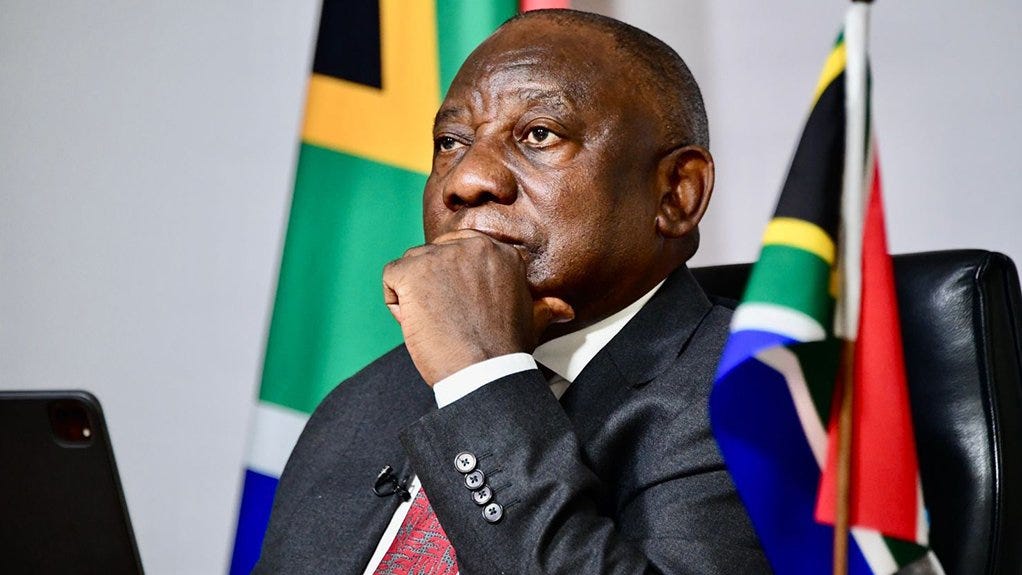
It needs to be stated for everyone, informed and uninformed, that it is unlikely that President Cyril Ramaphosa will step down before 2028. Not because he is running the country well, but rather that there lacks the precedent to show that any ANC president has resigned prior to the ANC elective conference.
Recently, watching a conversation on SMWX between political analyst Tara Roos and Dr. Sizwe Mpofu-Walsh, there seemed to be a strong belief that the president would step down before the soon expected 2027 election date. This was mainly due to the ongoing commission of enquiry that has the African National Congress, the president’s party, at the forefront.
It is extremely important to give insight into the fact that the currently suspended police minister, on special leave, Senzo Mchunu, has been a key figure in the allegations of Lieutenant General Nhlanhla Mkhwanazi. These allegations suggest there are close ties between criminality, politics, and policing in the country—particularly expressed and manifested through the disbandment of the political killing task team.
What is becoming more and more clear is that the president had no oversight over these processes but is believed to have known something as a result of his role and the expectations for him to be clear and aware of all the directives that occur in government.
Furthermore, there are close ties between Senzo Mchunu and President Ramaphosa dating back to the CR17 campaign when Senzo Mchunu was named as President Ramaphosa’s preferred Secretary-General candidate. This subsequently failed to happen after he narrowly lost to Ace Magashule. However, independent of the outcome, there has appeared to be close ties and a great deal of allyship between the two, dating far earlier than the allegations that occurred eight years later.
However, it is also important to note that, at the moment, there is very little tying the president directly to any of the allegations that have occurred. Yes, it may be believed that because it is his party, there may have been a willingness to look the other way; however, that is not a declaration of criminality.
Furthermore, looking more closely at the allegations themselves, Lieutenant General Mkhwanazi clearly stated his directive is to the premier and the National Commissioner of Police, and there is no need to approach the president. Additionally, Minister Mchunu seems to be acting on his own accord, absent of following protocol, and provided a directive in his own personal capacity—at least from what is known—absolving the president further from any apparent and evidentiary wrongdoing.
This does not rule out the belief that President Ramaphosa may have intended to protect his ally by implementing a commission of enquiry rather than an investigation. Furthermore, he allowed Mchunu to maintain all of his ministerial benefits while he was on special leave—an argument that even gave way to the uMkhonto WeSizwe Party taking the president to the Constitutional Court.
Nonetheless, it is apparent that the wave of optimism that once swept the country when President Ramaphosa was announced as the president of the ANC, and then the country two months later, has simply disappeared and, to some, may even be returning to resentment. But it is here that, as a nation, there has to be recognition that there has never been public pressure that has forced an ANC president out.
President Mbeki, after losing his re-election as ANC president for his third term, decided to resign as president of the nation after there was belief that he illegitimately used political power to find Zuma guilty of corruption. It was at his own choosing, nearly an entire year later after the election of President Zuma as the ANC president, that Mbeki resigned and was ousted from the job on 20 September 2008.
Similarly, after President Ramaphosa ascended to the seat of ANC presidency, accompanied by growing resentment and pressure from opposition parties and the ANC itself, President Zuma opted to resign on 14 February 2018 and gave way to our current president.
What is evident is that neither prior president has left the role of presidency prior to the ANC elective conference and until they themselves had lost control of their influence in the party. The same has to be believed for President Ramaphosa.
The impact of leaving the presidency, furthermore, does not only impact the president himself but additionally his party. Early resignation means that the ANC would need to find a new president absent a majority in parliament, but additionally with the president still having some degree of influence in the party—assuming he does not leave the post before 2027.
Already, the ANC, embroiled in a commission of enquiry, absent a clear successor, and currently planning for the 2027 election in and of itself, shows there is no apparent consolidated base that can push for the removal of the president while simultaneously working to find a replacement for him.
The ANC, over the years, has only become more factionalised and more competitive as access to state resources falters with the decline of the party’s electoral representation—meaning that the party that was once decisive about the way forward may lack that same clarity now.
Furthermore, there is no disregarding the fact that the ANC would have to work to find a solution with the other political parties in parliament to get a president to win a simple majority—fifty plus one. It was evident in this election that there is little that the two largest parties agreed upon other than President Ramaphosa continuing his presidency for a second term.
The incoming president does not have to maintain the current cabinet; they are allowed to elect their own cabinet and lead the executive in the manner that they see fit. This raises questions about the other partners who make up the Government of National Unity and their own futures in government if Ramaphosa were to depart prior to 2027.
Furthermore, where would stability be established if President Ramaphosa were to resign prior to 2027? It would not only mean a change in the president in the years leading up to 2027 but also potentially even more changes after the ANC elective conference.
The reality of the matter is that it would be a strategically bad decision for the ANC to have any more leadership discussions when the party is already under a microscope. Furthermore, Ramaphosa truly has nothing to lose by staying in the presidency.
Phala Phala is already in the public eye, and the commission is ongoing. Unless there are any more expected allegations, the country is set for a path that is focused on 2026. The ANC, out of all the parties, needs to appear unified with a definitive leader rather than the proposed world where they scramble to find who will lead them out of an extremely dark time politically.
If anything is to be believed, it’s that history repeats itself with different details. There is no world where either the ANC or President Ramaphosa intend to place pressure on the seat unless they, too, concede their governing ability in the lead-up to 2026.