

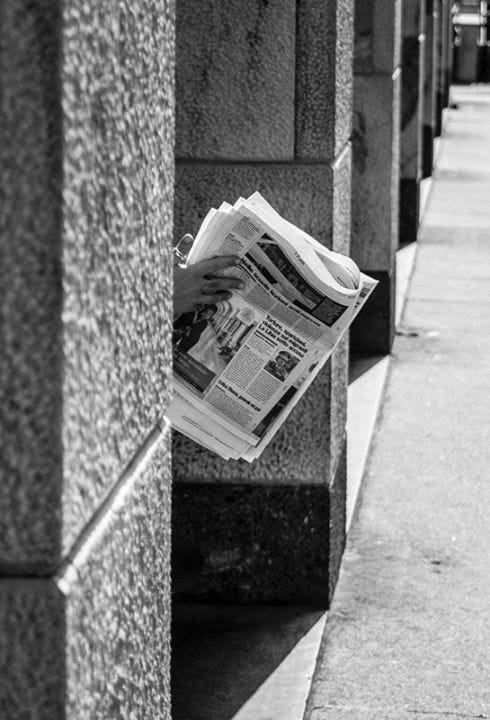
The photos that plagued the world about the injustices in South Africa were a testament to the importance of journalism—this being good journalism that is truthful, objective, and diverse. The decline of journalism globally and in South Africa should be every citizen's concern.
The recent reporting about the Mail & Guardian restructuring due to financial issues marked another key media entity going through struggles. After Beeld, Rapport, City Press, and Daily Sun moved to digital editions, and the print media logistics company under Media24 was sold off, this marked, for many, the beginning of the end of print media.
On the opposite end, media becomes digitized, and readers are unwilling to opt for paid media in extremely strenuous economic times in the country. Subscriptions continue to pile on, and the first that are culled are media subscriptions. Media has become too inaccessible for the average citizen to read and engage—this can only lead to a poor political environment.
In many ways, there are parallels between the United States and many of the countries turning authoritarian—countries riddled with individuals either illiterate due to failures in the education system or misinformed due to mass consumption of media and decreased interest in media. The political narrative is being stolen and dominated by an individual who is able to captivate the people as the saviour and invalidate the value and importance of media and expression.
Take the celebration of Ibrahim Traoré in Burkina Faso. He was quick to remove the French media from the country and, though having a great deal of success and progress, there have been reports of suppression of any opposition forces. No different to the United States, where Donald Trump and his administration continue to attack traditional media and suppress any internal opposition to their administration. Around the world, the media has lost its control and legitimacy.
This is a major concern. Without media, and with the rise of social media, there are no longer centralised places where everyone collectively receives information. Now, more than ever, there are disagreements about everything and anything because there is no institution in which there is collective belief—one that is allowed to adjudicate what is true or not.
It cannot go without saying that traditional media has failed in many countries, failing to be the unbiased institutions that report openly, fairly, and objectively. The genocide in Palestine highlighted that, once again spotlighting the failure of traditional media. But failure cannot delegitimize those institutions. At some point, there has to be recognition from all sides that they ought to change their approach and value their role—being accountable forces in society for politicians who fail to fulfil their burden.
The reality in South Africa is that media and journalism have been our court—our place for justice. It was a journalist who investigated State Capture and leaked the hard drive containing all the emails. It was journalists who continue to paint the vivid picture of the cruel injustices of South Africa. It was journalists who wrote about the endless nights where people danced away in Sophiatown.
However, with a population growing where, statistically, 60% of Grade 4 learners are unable to read for understanding, more citizens are unable to disseminate between the truth and the false promises vowed by politicians in every election cycle. As with many other countries that have seen their democracy come and go, there is no way South Africans cannot be wary.
Similarly, the media in South Africa needs to be held accountable and report more honestly. There is no means of denying the biased reporting that paints particular parties in a certain light and others not. The objectivity, the depth of journalism, and the commitment to South Africa to be a progresser of the truth—and not a creator of reality—may re-establish some degree of trust. South Africa as a whole needs to be honest about its dishonesty.
A world without journalism is one where politicians are not exposed for their self-indulging actions. One where there is no central reality that speaks to how the world is and the different roles everyone plays. One where the voice of the people is fragmented and broken into subsects where disagreement is favoured over agreement.
Journalism liberated South Africa. Now, in this moment where it appears to be dying, the world needs to liberate journalism. For if not, the clock will return to a time where only a select few had the ability to express what their constituency was going through.