

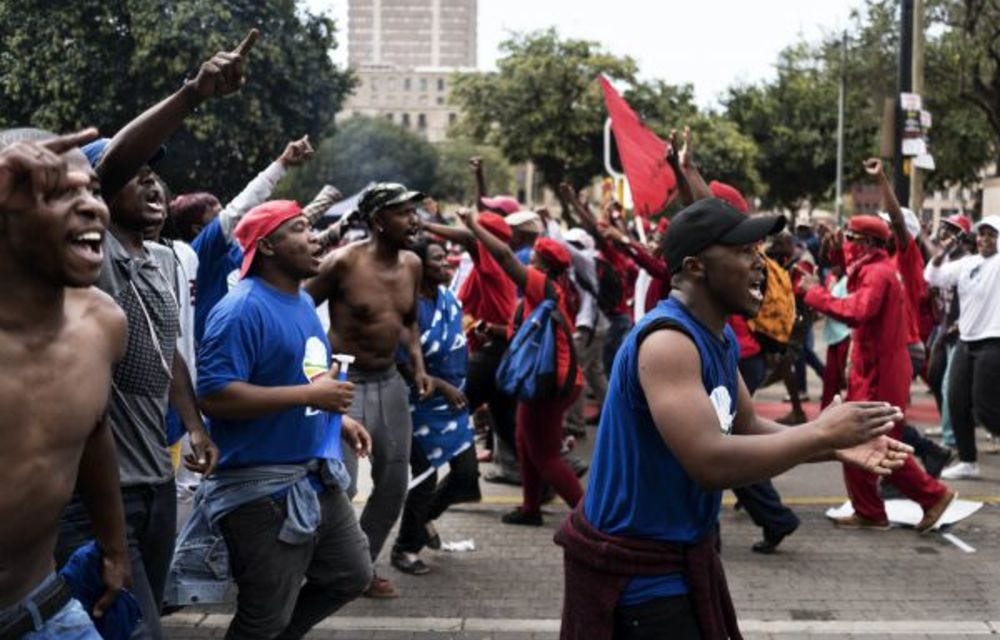
False promises have eroded political trust and participation within South Africa. The continuing belief in the promise of a better tomorrow fails to impact South Africans in their current form. The current state of South Africa only propels us further into grander visions but with even less execution.
In President Ramaphosa's first term, he promised a “renewal” and a “new dawn” to all South Africans. Six years removed from that speech, the ideals of renewal or a new dawn never sparked an improvement in any South African lives. Unemployment statistics rose as crime rose in parallel. South Africa, shackled by the Zuma era, had believed they were to be given a chance with the new president. What later became termed “Ramaphoria” was the promise of a better tomorrow for all South Africans, regardless of socioeconomic status.
Later, in the build-up to the national election, the promise to “clean up corruption” within the ANC was forwarded as a key priority for the new ANC president. However, State-Owned Entities (SOEs) continued to be ravaged by mass corruption and infiltrated by crime mafias. Eskom faced significant infrastructure issues, such as unmaintained machinery and sabotage, leading to “Stage 6 Load Shedding,” which left communities without power for more than 441 hours. The optimism felt by South Africans began to wane.
Accompanied by the pandemic and civil unrest, President Ramaphosa's national address, which became known as “family meetings,” depicted endless promises without any follow-up. After the procurement of a R500,000,000,000 grant for COVID relief, stories appeared in major media outlets stating how PPE money was stolen from communities and tenders were falsely awarded. Additionally, Minister Gayton McKenzie published a list of artists who benefited from the artist grant, revealing mass disparities among individuals who received relief, with a cumulative payout of R72,000,000 to 3,962 beneficiaries. It was clear that there had been much dealing or mismanagement during the payout of the funds, which once again showed a failure to weed out corruption from the government.
However, the idea of promising people isn’t unique to President Ramaphosa. Former President Jacob Zuma had promised six million new jobs and five million new houses. Additionally, he promised free higher education for poor and working-class students. At the end of his term, there was no delivery of the majority of the promises he made to people who affirmed their faith in him and his ability to ensure service delivery to those communities.
Furthermore, EFF leader Julius Malema has amassed quite a loyal supporter base based on the promises he makes to his loyal supporters. Having made a statement about “increasing current social grants payments by 100%,” a similar pattern occurs. There is a promise that is made without a legitimate means or idea for implementation. So, people latch on to these ideas because they are the ones that will guarantee liberation from the context in which it is premised. This incentivizes even grander and larger promises as time progresses to forget the lack of fulfillment in the previous promise.
The EFF was premised on “economic freedom within our lifetime.” There was a clear goal set about what the aims of the party should be. However, over the years, as a means of mobilizing individuals, there has been a shift to more socialist rhetoric. The attacks on policy and legislature about existing “White Monopoly Capital” quickly shifted to criticism of the ANC and the lack of accountability that existed. Even recently, a greater shift in the party’s line to allow open borders and a pro-Pan-African stance once again depicts these large political shifts as means of staying relevant.
The validity that exists within many of the arguments is lost due to political rhetoric which misguides individual faith and belief. The promise of access to housing and education has been an existing promise for over 30 years. Many basic services were affirmed as being provided through the constitution and the freedom charter. But due to mismanagement, corruption, and false promises, it has led people to latch on to even stronger ideas with greater incentive to mobilize, but being led by people who lack executable plans. Trevor Shaku, the national spokesperson of the SA Federation of Trade Unions (Saftu), complained that the 2024 elections are full of “bourgeois political parties who differ in logos but are similar in their ideological inclinations,” which shows disillusionment between politics and civil society.
However, politics is about attracting audiences and gaining supporters who are loyal to the cause and to the party. As politics get fractured and become more contested, the prediction is that the ANC is expected to continue on a decline. Amassing a loyal audience can only be done by finding a unique identity, regardless of how politically suicidal it may appear. “Mabahambe,” used by Minister Gayton McKenzie, actively encouraged afrophobic rhetoric within the nation.
Globally, a turn to populist politics means that people are being led astray on feelings that can’t be actualized, and they are being promised grand improvements to their livelihood even when the state has the intentions of doing the complete opposite.
So, as politicians move into a more competitive space, it is important that they find means of regulating the promises made and how we inform South Africans about the capacity of parties beyond manifestos. The promises that filled millions of homes left many families hopeful but without an improvement in their circumstances.