

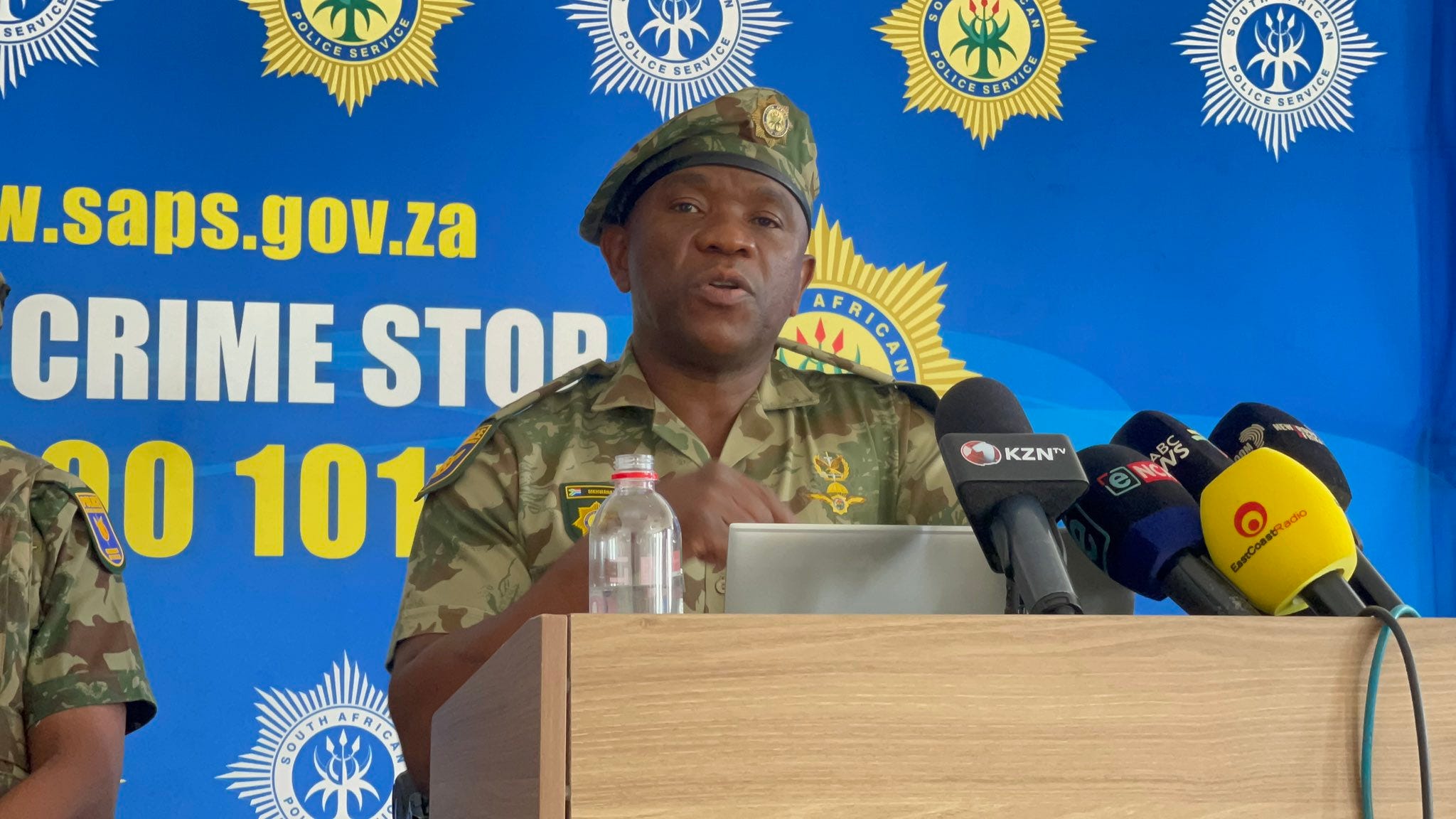
What happens when men in uniform become the heroes of the state? KwaZulu-Natal Police Commissioner Lieutenant General Nhlanhla Mkhwanazi had a bombshell media briefing that implicated the Minister of Police, Senzo Mchunu. It marked not only a challenge to authority but a potential opening for political battles within the police.
Many South Africans watched the press conference that affirmed a belief long held by South African citizens: that the South African Police Service has been allegedly infiltrated by a syndicate that includes politicians and members of the police force. This was no longer a media briefing but a moment in which criminal information had been shared, marking General Mkhwanazi as a whistleblower.
The media briefing marked the announcement of the start of an investigation against Minister Mchunu after bombshell evidence was provided to the public, alleging that the drug trade in South Africa had contributed to the hindrance of effective accountability.
According to General Mkhwanazi, there have been active attempts to infiltrate and deny justice. He revealed that a total of 121 cases that were under investigation were taken away from the political killings task team before its disbandment, after certain high-level individuals aimed to not be linked to the crimes that were under investigation.
This moment brought shockwaves through the country. Many praise General Mkhwanazi as one of the few honorable civil servants who still aim to achieve justice and accountability for all South Africans. It marked him a hero, but it was at this moment that concern should begin to grow.
Many people on social media compared General Mkhwanazi to the likes of Ibrahim Traoré, the leader of Burkina Faso, who rose to power after an internal coup within his country. It lamented a growing appreciation for men in uniform who represent the people.
The briefing was a moment where South Africa, for once, publicly faced its lack of accountability and its own criminality, which politicians, civil servants, and lucky individuals have been able to benefit from for years. This is the fight for the institution of SAPS and the fight for South Africa, led by General Mkhwanazi—a man in uniform who will die for his country and fight for his people.
No different to the multitude of African leaders who usurped power after politicians and democratic systems failed. The country ought to err on the side of caution, for if unchecked and unregulated, this may be more than just a fight for SAPS—but rather a fight for the country as a whole.
Optically, within the briefing, General Mkhwanazi—flanked by armed policemen on both his left and right, holding weapons and dressed in the SAPS Special Task Force uniform—declared he was ready to die for the police badge. This marked a key moment in a soft internal battle that is bound to take place within SAPS, a battle that will be adjudicated by the public.
General Mkhwanazi, in closing, went on to say, “What I said when I started, that I've decided to take this fight head-on. So the least that can ever happen to me is for someone to come and attack me, or somebody to issue instructions that Jerome Mkhwanazi must be fired from the police, or suspended, or arrested for that matter.” This was a declaration of the battle for the soul of the SAPS.
After this briefing, what became apparent was that there is a growing split between good and bad cops within SAPS—specifically viewing General Mkhwanazi’s view of implicated police officials. He stated, “Surely there can never be peace between a criminal and the police officer.” There is growing concern that policemen will be labeled criminals within SAPS.
The overflow effect is that SAPS has gotten to a point where police officials are actively suing one another, launching investigations, and hindering the efficiency of SAPS. This only marks the beginning of a long public fight, where there will be intent for there to be victors and losers—and claims to have cleaned up SAPS.
But this media briefing was by no means normal. This media briefing was a declaration and drawing of lines in the sand—to declare those cops who stand for justice and those who do not. General Mkhwanazi’s call to all “men and women in law enforcement, the South African Police Service and Metro Police to stand up and protect our people. Yes, sometimes law can stand in the way to achieve justice. We must choose justice,” spoke to a potentially larger, worse internal rot of the policing system that needs to be fixed.
However, the real question that is of larger concern is: why now, and why in the way that it was done? Information that tends to be considered classified in an investigation was shared while it is ongoing. This was not a media briefing that brought any justice or accountability, but rather shed light on a dire situation—but without much motive or explanation.
There is always an air of caution that needs to be approached when discussing such high-profile cases that seem to have gone astray. There is no doubt that the evidence that has been provided may be legitimate, but the processes that allow the courts to decide seem to no longer be a point of concern.
Some may argue that due to the allegations that have exposed a state captured and controlled by syndicates that peddle drugs within the country, this may have been the only way of achieving justice and getting some action.
Already, the DA, EFF, ActionSA, and Rise Mzansi are writing letters to the Speaker of the House, Thoko Didiza, to get an urgent hearing on the matter, with some calling for an investigation into the matter and the police as a whole. It has placed a great deal of urgency on the matter and created a political battleground that will likely see both the ANC and the DA go at it, as another official is alleged to be involved in corruption—who is in President Ramaphosa’s cabinet.
Conversely, there are some who believe this has violated the post of the Commissioner. Forensic investigator Paul O’Sullivan wants General Mkhwanazi to be held accountable for his statements: "The reality is that he was not authorised to do what he did.” This shows a growing schism within SAPS that does not pride this moment as a good moment for policing nationally, depicting potentially a deeper and darker fight that will appear in South Africa.
In the moment, in the hour that South Africa will cite for years to come, General Mkhwanazi may become a national hero. That briefing signified that he refused to stay silent and be an observer of criminality within the country that he continues to love and fight.
Moreover, he named people who continue to benefit from their position of power and escape accountability. This was not an unmasking of a single official, but it was the unmasking of a system that has failed millions of South Africans on a year-on-year basis.
Corruption and crime do not occur in isolation or are committed by one person. Something that became extremely apparent with the Zondo Commission and State Capture. It takes multiple individuals who are willing to look the other way for their own personal enrichment and forgo their obligations as civil servants—while South Africans bear the brunt of their lack of fulfillment within their role.
This moment is definitely the start of a new time in South Africa. It may lead to improvement in accountability and investigation into criminal syndicates that are well integrated into the state of South Africa. On the other hand, it may just fuel more political—and now police—killings, and may be the start of a waging conflict between the good cops and the bad cops within South Africa.
Over the next few weeks and months, as the country grapples with a reality that many were far too aware of, it may open a completely different path. The question now is: who leads us? Will it be politicians, or will it be men in uniform?
I hate to be the one to ask if the men in uniform are such a bad idea?