

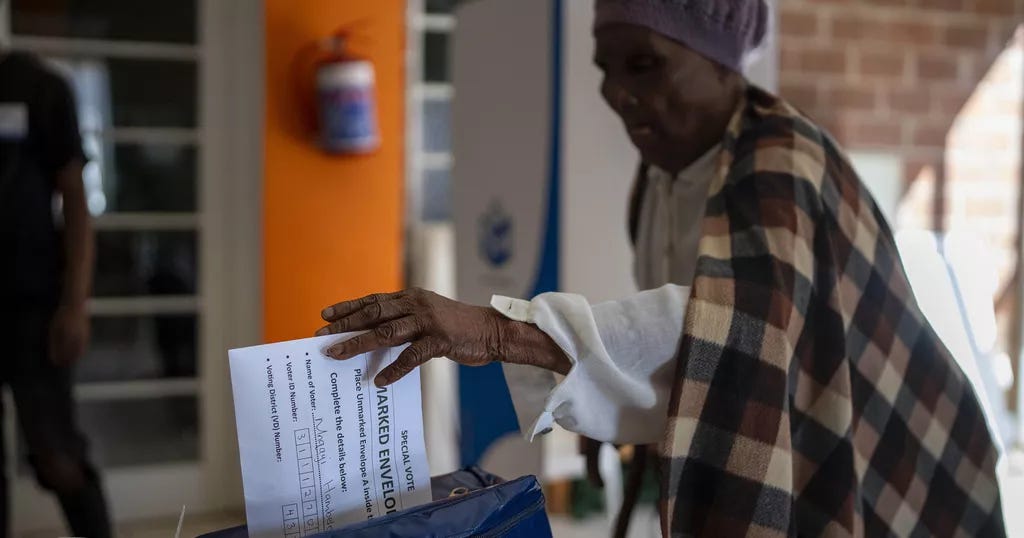
Morning after the elections, we are primed to sit in front of the news for the next few days as the IEC collates the results and finalizes the allocation of seats in Parliament. Already, predictive data, CSIR predictions, and comments about the election process have added to this tension and the feeling that we are on a knife edge. But let's engage with the various scenarios and their outcomes.
Preemptively, it must be said that a lot of this is predictive and assumes quite a lot based on the data engaged with. There is a likelihood that the data may be incorrect and that there may be some anomalies as the day progresses. But let's engage with the data.
For the entirety of this article, we will use the CSIR 2024 National Ballot Overview, which many political analysts, the SABC, and other South Africans use to determine the general outcome of the election. Based on 2019, which stated the ANC would hold 60% and the EFF would hold 9%, the polling data was off by 2 to 3 points, respectively. The ANC performed just below their expected outcome, receiving 57%, and the EFF overperformed, receiving 11%. With that, there seems to be a relative room for error of around 2%, which allows for some speculation.
Firstly, let's engage with the new kids on the block in the national election: ActionSA, Rise Mzansi, and Build One South Africa. All new parties were established in 2023, excluding ActionSA, which was founded in 2020. The parties seem to have captured the youth and social media world. Much of the talk going into the elections is focused on them. However, they seem to have had very little impact on the polls. Much of their popularity does not seem to be resonating in actual votes. ActionSA had a good showing in local elections in 2021, gaining 2.36% of the vote nationally if you accumulate all their votes in different municipalities. It would have been expected for them to grow and continue with their momentum. Due to the introduction of new parties, their vote seems to have been spread amongst the three parties. Additionally, with both ActionSA and BOSA being viewed as pro-Israel, it is likely they lost much of their liberal supporters who tried to find a party that most aligned with them. So, for the new parties, it is likely they will refocus on the 2026 municipal election and execution plan for 2029 and beyond. Though much of their hype did not translate to votes, they seem to be developing strong loyal support bases, and with the experience they gain over the years, it will build voter confidence. I do expect each party to have at least one seat in Parliament and to play some role in provincial government.
Secondly, let's turn our attention to Umkhonto weSizwe and the Patriotic Alliance. Both parties, entering the election as political opposition to major parties in their respective provinces, continue to show that their leaders have a connection with people from their communities. Jacob Zuma's return to politics with MK showed that he continues to have sway in KwaZulu-Natal and the Zulu nation, as in their first contested election, they are predicted to claim 7% of the national election, which opens up the potential for them to be the third-largest party. They continue to show that they are a force to be reckoned with and potentially a player in coalition negotiations. The Patriotic Alliance, which contested much of the DA 'coloured vote,' also showed a positive result, contesting very effectively in the Western Cape against the DA's dominance and gaining a potential 2% in the polls. The party may find much validity in the next few years to be considered a governing party. Both the PA and MK were successful in ensuring that they contested the elections and decreased the support of the major parties (ANC and DA, respectively) in their provinces of concern.
Thirdly, let's examine the EFF. Based on polling data, the EFF has taken a heavy hit from the 11% it once held in 2019. As people became more disgruntled with the ANC, it seemed natural they would drift towards the EFF or opt out of voting. Thus, much of 2024 was meant to be a homecoming for the EFF, where they were meant to contest to be the official opposition. However, predicted to receive just 7.7%, the EFF has had a major decrease in its supporter base and also risks falling to be the fourth-largest party. With the CSIR's 2% leeway, MK could potentially grow to be the third-largest party in South Africa. As they only sit 0.7% behind the EFF, there would be concern internally within the EFF that much of their assumed negotiating power has diminished, which in turn limits their chance of being part of the official government. Additionally, it also raises the question of whether people supported the EFF wholeheartedly or simply housed their votes there until they found a better alternative to the ANC.
Finally, let's consider the major parties, the ANC and the DA. It is evident that after all their campaign attempts, addressing load shedding, and signing the NHI bill, the ANC did not see the improvement required to pass the 50+1% threshold. This places the ANC in an interesting position where they are still expected to hold the majority, gaining around 42% in the election, but are unable to form a government on their own. This places their opposition in an interesting place. The DA outperformed most polling data that expected them to finish around 20% and is predicted to finish with around 26-28%. This would be the best result for the DA in years and also places them in a position to impact negotiation quite heavily. Already, with the MPC being called into question and aspirations for a government of national unity, the DA has to make a decision on whether or not it will be willing to partner with the ANC. After years of being in direct opposition to one another, the alternatives only harm the interests of many DA supporters. In a world where the ANC is in coalition with the EFF and Julius Malema is given the role of deputy president, there is a prevailing fear that the country will dissolve, even though many of these sentiments seem extremist and lack factual evidence. The DA is primed to protect the interests of its supporters by actively participating in government and potentially cleaning the system from the inside. Alternatively, they could utilize the MPC and gather a government of opposition parties, which would require the likes of MK and the EFF to opt in to achieve 50+1%.
However, the ANC is not hamstrung. The ANC has a variety of options presented to them, which provide various outcomes. They have the option to look to MK and the EFF for coalition government, which would be interesting considering all these parties' leaders have had history within the ANC. Alternatively, they could look to opt into a DA coalition if the proposal presents itself. Uniquely, the ANC is very unlikely to hold the power in the negotiations because a large concession from the DA would be required to come into coalition with the ANC when they have actively fought against them and intend to take them to court over the NHI act. Or they could opt to collect smaller parties to get them over the hill; however, with their experience running the city of Tshwane and Ekurhuleni, it has been evident that coalitions with multiple parties lead to a lot of instability.
So, there is a lot to consider over the coming days, and various people will make up scenarios and outcomes that favor their party and themselves. Watch the discussions parties are having, the sentiments political parties share, and the increase/decrease in political debates and criticism from opposing parties over the next few days.
Sizwe Mpofu-Walsh tweeted this morning, “Welcome to a new country.” Indeed, we are in a new era in South Africa. This truly is the change in our democracy, which happened so wonderfully 30 years after our first democratic election.
To those overthinking and spiraling in the possibilities and the potential outcomes, remember to take a break. To those who are invested/disinvested, remember this is our country and this is our democracy. Regardless of what happens, we are all South African
.