

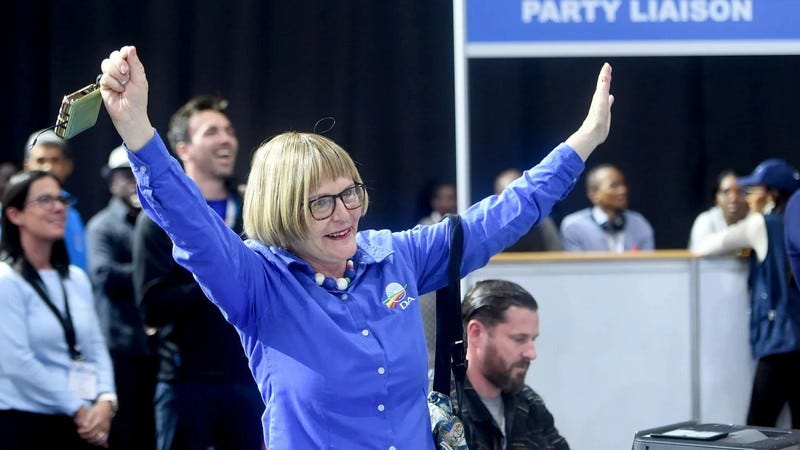
The genius of Helen Zille continues to go unnoticed in wider South African politics. Having been committed to the party for nearly 25 years and holding a multitude of strategic positions within the party, she has made a return to politics and completely changed the outlook of the Democratic Alliance (DA) and South African politics.
Many years ago, she recognized the potential demise of the ANC. However, in this recognition, she also identified a true development in South African politics. After the 2014 election, during a talk, she explained that the DA represented the right of politics in South Africa alongside a few other minor parties such as the IFP, GOOD party, etc. She then discussed the growing left, which had been represented by the EFF. At the time, the EFF established itself as the party for the people, prioritizing wealth redistribution to all South Africans. With these two political parties opposed to each other, she explained that there was already political contestation within the ANC, leaning to each respective side from various factions within the party. She almost perfectly predicted the splits that have become more apparent in recent elections. She explained the largest strategic failure the DA made, which set them back quite some time.
In 2016, after the municipal election, the City of Joburg, Tshwane, Ekurhuleni, and Nelson Mandela Bay were left with hung governments, with political parties struggling to reach coalition agreements. In a last-ditch effort, the EFF handed the DA their votes, allowing the DA to govern major metros in South Africa. However, many conservatives within the party believed this to be a major error, which it was. Many conservative supporters turned to more conservative right-leaning parties. The DA had its first election without an improvement from the last. Already being given a hail mary with President Zuma stepping down and corruption being at the forefront of the ANC and its officials, it would have only been assumed they would have seen astronomical growth. Many within the party believed it was the fault of Mmusi Maimane, who was newly elected leader of the party in 2014. However, many outside the party felt he was scapegoated and removed illegitimately. With much rumor about the growing discontent and tension between himself and Helen Zille, it led to many officials leaving the party, including Herman Mashaba, former Johannesburg Mayor and current leader of ActionSA. It left the DA having to choose a political future for itself and the fate of many supporters.
Recovering from a disastrous election, Helen Zille was elected DA’s federal council chairperson. Many saw this as political maneuvering after clearing out party officials who called for a more inclusive and liberal DA. The DA leadership did everything within their power to ensure that the DA continued to appear as the opposition to the ANC, calling for an investigation into the Cyril Phala Phala incident. They continued to isolate the ANC and paint themselves as the opposition. However, as soon as they recognized the potential for the DA to be locked out of power if the ANC opted for a coalition with the EFF and/or MK, they framed themselves as the only true alternative, cautiously navigating the unexpected drop in support the ANC was facing, as shown in most polling data. With many parties not believing the ANC would drop to a mere 40%, the DA recognized their need to be in power.
With a sudden change in heart after the election, the DA began to tone down their anti-ANC sentiment but continued to push the sentiment of the "doomsday coalition." This calls back to Helen Zille’s recognition that the ANC was split. Much of the media was filled with stories about disgruntled ANC members as they opted for a working relationship with the DA. With the support of Cyril Ramaphosa and the ANC, an open invitation was given to parties to join the Government of National Unity (GNU). However, as many media outlets have begun to uncover, it lacks the representation and unity it hoped to inspire.
Already, the GNU is showing signs of weakness, much due to the brilliance of Helen Zille, who was part of the negotiation team that reached an agreement with the ANC. Helen Zille firmly cemented the power of the DA in the GNU. Being the second-largest party by a substantial amount, the DA is the only party that can effectively engage in passing policy, holding a collective 60% with the ANC. This requires the ANC to pander to the DA rather than the other way around. Moreover, requiring 60% of general consensus within the cabinet of GNU members to pass policy, the DA holds 30% of that power. With fractures already within the ANC, the DA and Helen Zille appear to be the only stable entities within the GNU. Already, Helen Zille has objected to the Patriotic Alliance joining the GNU as not all members were consulted. To some degree, it would be assumed that the PA is already a growing threat to the DA in the Western Cape, so having the PA could bring much unwanted competition and tension for the DA.
However, it has not worked out as well as it is made to seem. Though the DA is now part of many governmental structures and has the ability to keep the ANC accountable, many supporters of the DA have not been pleased with this coalition. Even after DA leader John Steenhuisen said, "We need to stop the finger-pointing and should come to the negotiation table," it is likely that many conservatives who supported the party may opt to leave if the GNU fails to promise results. Additionally, the DA did not see statistical growth at the polls, which could potentially indicate diminishing support.
Without the strategic decision-making of Helen Zille and her recognition of the future of politics in South Africa, which will establish itself as a battle between the left and the right on the political spectrum, the DA has firmly affirmed itself as a leader in the future of governance and the idea of coalition governance.
The return of Helen Zille to politics has shown a long-term commitment to a plan where the DA becomes the sole voice for the right. It is halfway there, holding positions in local, provincial, and national government. Now it is on the supporters to decide whether this is political brilliance or political suicide.