

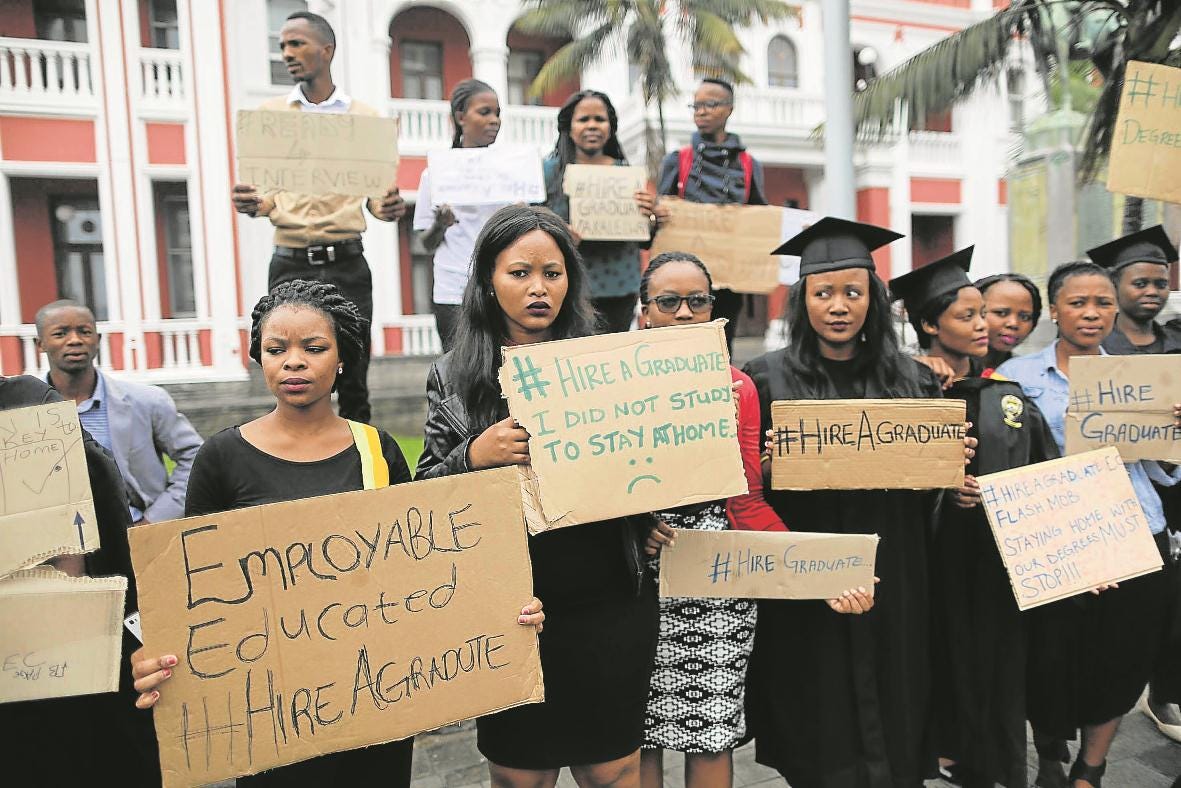
Are South African youth beginning to give up on the political system? If so, who is responsible for bringing them back into the fold and reminding them of the importance and value of the vote?
Around the continent, the suppression of freedom of speech, long-tenured rulers, and less and less priority on free and fair elections has led many to forgo the idea that the political system that previous generations once fought for will bear the fruits that were promised with democracy.
Kenya, for the last two years, has had youth-centered protests. After last year’s unfavourable tax bill was implemented, this year marked an anniversary since the protest, which sparked major clashes between the youth and citizens.
Roughly about 60 people were killed last year. This year, an estimated 19 people were killed and 531 wounded in the looting and violence, which was labelled an "attempted coup" by the interior secretary. This was a telling sign that the government no longer had an open ear, but an intent to continue to hold on to a grasp on power—something that became more apparent in the East African region amongst neighbouring countries Tanzania and Kenya. But the question is: what relevance does this have for South Africa?
Looking back at the start of the year, the student protest that culminated 10 years after Fees Must Fall indicated two things: firstly, that young South Africans continue to be failed by the system, and secondly, that the government has been unable to resolve an issue for over 10 years. It indicated that the political system, which is still dominated by the same parties—except this time with coalition partners—has not been able to tangibly affect the lives of people on the ground positively.
Many will attest this to young people not voting and playing their part within politics, but even now, a year since the formation of the Government of National Unity, there has yet to be the change that was promised. Moreover, the ANC and, to some extent, the DA continue to act self-interestedly, prioritising their own parties' wellbeing rather than governing and solving the issues for South Africans.
This issue does not only extend to the voting youth of the country but also to the youth who are en route to vote. Voting begins to seem pointless—the more elections South Africa has had, the worse the material conditions have gotten—leaving them without a clear way forward or real options they can actively believe in.
The decrease in election participation is not only a lack of faith in the vote and its ability to lead to change, but also a decrease in trust in all state institutions. Civil servants no longer have the motivation to actively contribute in a manner that is of assistance. Corruption becomes the name of the game because accountability becomes more rhetorical than legitimate action that can be enforced.
For decades, allegedly implicated and corrupt officials have been able to live their lives unaffected—enjoying the wealth and riches that were meant for South Africans. The July 2021 unrest marked a key moment in our history, where South Africans took matters into their own hands to enrich themselves and loot from themselves—not the state. This signified a country losing hope in the state as a whole.
The effects of a stagnant and unresponsive system have also given birth to more extreme parties. The rise of the EFF 11 years ago, and now the MKP—which dominated elections—continues to give platforms to radical ideas and leaders who aim to maximise the pain and hurt people are feeling. They advocate for an overhaul of laws and, in some instances, the suspension of the Constitution, removing the protections that South Africans rightfully have. There is a growing need for change in South Africa, and sadly, people are beginning to believe it will not happen through the ballot.
Analysing voter turnout amongst young South Africans aged 18–19—once one of the most formidable groups, averaging around 70–80% turnout in the previous three elections—saw a drastic decline to 45%. A number which is extremely low, considering there is already underrepresentation of registered voters in the youth.
Currently, registered voters aged 39 and below represent only 39.21% of registered voters—totalling 10,950,295 people, just over half of the 21 million South Africans aged 39 and below. Increased apathy and the sharp decline in 2024 from the previous national election means that number and proportion will only get larger. The youth and South Africa stand at a crossroads without a clear solution.
The reality is that many South African parties are arising and struggling to differentiate themselves in policy and politics. It appears as though many people make the same political choices—just with different faces. This stems from national, provincial, and local governments that fail to hear the people and provide them with real-time solutions.
The National Dialogue scheduled to happen in August represents a similar belief. Top brass South Africans are once again going to talk about the issues most pertinent and apparent in South Africa, without there being plans for execution and implementation.
Now, more than ever, the calls for young South Africans to vote will do nothing if the system fails to respond. But worst of all, it will continue to make people disillusioned with a system many fought so strongly for.
On the opposite end, looking at the demographic of those who vividly remember the struggles of the past and the oppression that once dominated—the age groups of 60 and above continue to average a voter turnout of 73.5%. They continue to believe that the vote is important and may result in some sort of governance improvement. At the very least, it makes them feel as though they have fulfilled and honoured those who fought for them.
But it has slowly become apparent that South Africa has made this generational divide. It is on the youth to find the solution, it is on the youth to vote, and it is on the youth to free us from this nightmare. Without the stories of the past that etch the sacrifices made by millions of South Africans in uMkhonto weSizwe, the UDM, the South African Students' Organisation, the PAC, and the ANC, the country would not be where it is today.
Many activists and struggle heroes attest to learning from the leaders of the past—engaging in shared knowledge, principles, and collectivisation that said they were one, fighting the same system. This expanded beyond generations and spanned across the continent in the form of Pan-Africanism.
It is important, now more than ever, regardless of where it is on the continent, that when democracy is under attack it should be a collective fight—sharing resources and asylum with our neighbours rather than remaining isolated from the battles of those in other nations.
The decline in voting participation is not a singular group's responsibility. It is important that civil society, international organisations, and political parties pay attention to an issue that threatens not only democracy itself but our Constitution. If not, the country as a whole risks becoming morally bankrupt.
In the words of Ernest Hemingway:
“How did you go bankrupt?”
“Gradually, then suddenly.”
It is important the country is not blind to a growing issue that could one day give rise to a different way of politics—one where the people have no vote or voice