

The political discussions in Johannesburg pertaining to the Local Government Elections feel ignorant to the reality on the ground for many residents of Johannesburg. It aims to make a farce of the decay that has existed in the city long before political campaigns.
To be frank, South Africa needs to break away from the doomsday politics and engagements. They leave little room for South Africans with influence, particularly the one percent of the country who have access to media—News24, Daily Maverick, 702, and this list—to see the full scope of the country’s politics.
It is evidently clear, in Johannesburg and Helen Zille’s mayoral campaign, it is positioned as a means to saving the city. In all reality, the city has been needing saving long before Helen Zille thought to make it a political campaign. It is a city that has been riddled with problems from crime, unemployment, infrastructural degradation, and mass migration. It does not need a new face, but rather a new spirit that addresses the problems that are core to people who are not online and reading the media.
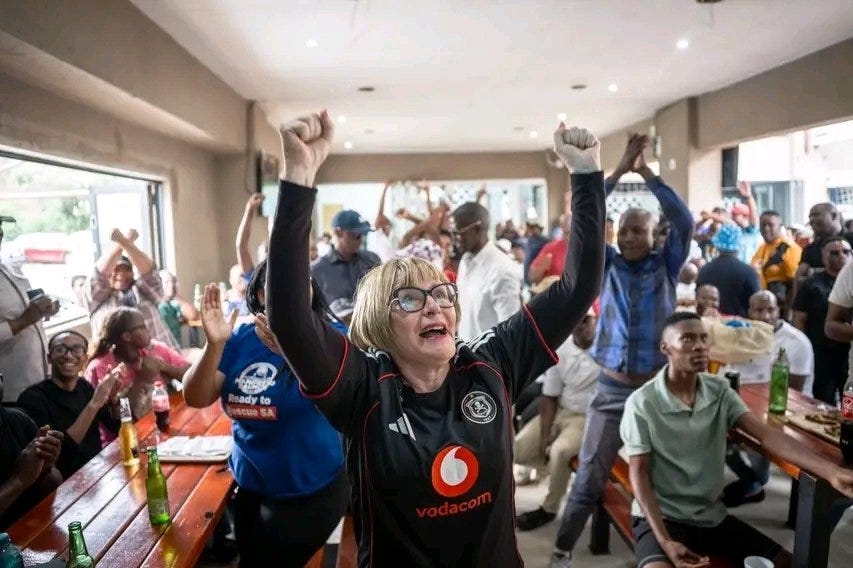
Once again, Zille took to announcing that she would not work with the EFF and the MKP. She already enforced she is not intending to be a unifying force in a city that is ignorant to inequality. A city that reports selectively on the issues of water and electricity, especially when those issues hit poor, black, and brown communities. A city where potholes in Alexandra were not the concern of the public but potholes in Hyde Park mark the city crisis. Zille rather chooses to be the person at soccer games, taking in the 90 minutes when it is easy to forget the differences of the beautiful city which is Johannesburg.
A city that continues to deal with the aching pressure of a failing health care system and mass migration. Where xenophobia continues to be on the rise as resources become restricted and hospital queues become unbearable for the average South African. She is not a proponent for the National Health Insurance Act, which would have eased the burden for South Africans who remain structurally restricted from private health care and medical aid. Will she have a solution when the people are truly deserving of their basic provision and rights, not luxuries afforded to them.
It is going to be a hard question once the strike is not a policy but a character that will define who the next leader of Johannesburg will be. It is not going to be a saviour or person who is propped up by the media but someone who beyond their principles is pragmatic of the problems which face both Johannesburg and the world.
Conversely, the ANC needs to show not that they are a party beyond their word but that they actually are willing to be a modern political party. The struggle and the past to many young South Africans who continue to watch them live comfortably and be driven around in vehicles provided by the state are unable to eat slogans. It is about time the party becomes more apologetic about its failure but pragmatic. To truly show that they can be the leaders who will be referenced in the future. It is their moment to show that they can progress past factional politics and inward focus rather than a community driven view.
It is also a time for the country to truly ask of itself what South Africa’s political future looks like now that coalitions are central and core to our politics. Directly as a result of the proportional representation system. There can no longer be good guys and bad guys, nor can there be opposition or alliances. The politics of South Africa’s future have to be fluid and have to honestly be critical of all parties equally.
The reality is that the political spectrum and diversity of the country is much larger than the ANC and the DA. uMkhonto weSizwe Party, the third biggest national party went unnoticed and unspoken about by the media. Minimised Zulu nationalism in the previous election, completely missing sight of the growing disgruntlement with the ANC and the deep admiration and loyalty for the leadership of former President Jacob Zuma. It represents 14% of the country; it is a reflection of people and their democratic choice and needs to be engaged with beyond the surface level stereotypes.
Interestingly, the Patriotic Alliance in this election has interesting space as it continues to be in the electorate of the DA and ANC respectively. It may represent another moment in time in politics where a party goes unnoticed and unspoken but after the election shocking more than a few media houses but an entire nation. But that is too speculative to say for certain and only time will tell.
As all these political parties—big and small. New and old, with the same faces who made the same promises to the same previously more youthful, hopeful and aspirational South Africans. Truly need not to make this about them and their grudges but to speak to South Africans about a plan backed by data, research and timelines that can be used to measure success or failure.
It is this moment in Johannesburg in this city for the first politically mature politician to come to the city and not save the city but help the city realise the beauty, the solution is not in politics but in the people. In every single person who walks and makes the city and sight to witness.
They do not need to always wait for the government to be of assistance and find means to be of assistance to one another. That they must not be bound by the class boundaries that define Johannesburg and develop a community where equality is more than an ideal but an action and mechanism that is applied to all practically.
Accepting that those who have may have to give what they had for someone else to have just as much. To have a chance at the same opportunities, to be given the same dignities to live their lives has been enjoyed by so few in Johannesburg. Does not mean giving up everything, but it does not mean hoarding, building larger walls and investing more in private security but investing that same money into the communities that lack recreational centers, libraries and quality education.
The remarks should not always be the government is failing but rather how collectively as people who have the means do something about the failure. How is it that we contribute to that failure, could improve it so that failure is slightly better and not just left for a third party, a force outside of ourselves and our communities can develop.
It is not always possible to change the world but it is possible to make your corner better. To make sure that life is better for just a few more people who continue to be led astray by people who play the theatre of politics. Until the next person who leads the city is from the people, deep from the belly and under the world of the lovely city. There will be no saviour for Johannesburg, Jozi or Joburg for it will not be a force that unites the golden city to produce golden minds.
The future of the country lies within the people. This is another moment for the people to show that they need politics to benefit them and not for them to be the means to an end. The people need honesty that truly asks of our country to face our problems not in the days to come but now for if not, the city will be a city “doomed for collapse” forever. When it is a city simply in need of the people to give truth to their voice and to be heard rather than sidelined.
But as I have come to believe, this can only be but one wish. When the reality will be starkly different. Johannesburg is the gold city. Its potential is blinded by those who allow it to be seen as a place only for personal gain and not communal development, expression and home to millions and millions to come. It is a city whose beauty is masked by the illusion and tricks that give way to problems that do nothing for the people on the ground. But it is a city that continues to go on. A city whose hustle and bustle is unaffected by the rotating mayors and failing system of democracy they have been accustomed too.
The election in Johannesburg truthfully may once again reflect the interest of the few who continue to exercise their rights. While the millions who make the city wait on for things to change on their street, in their home and in their community.