

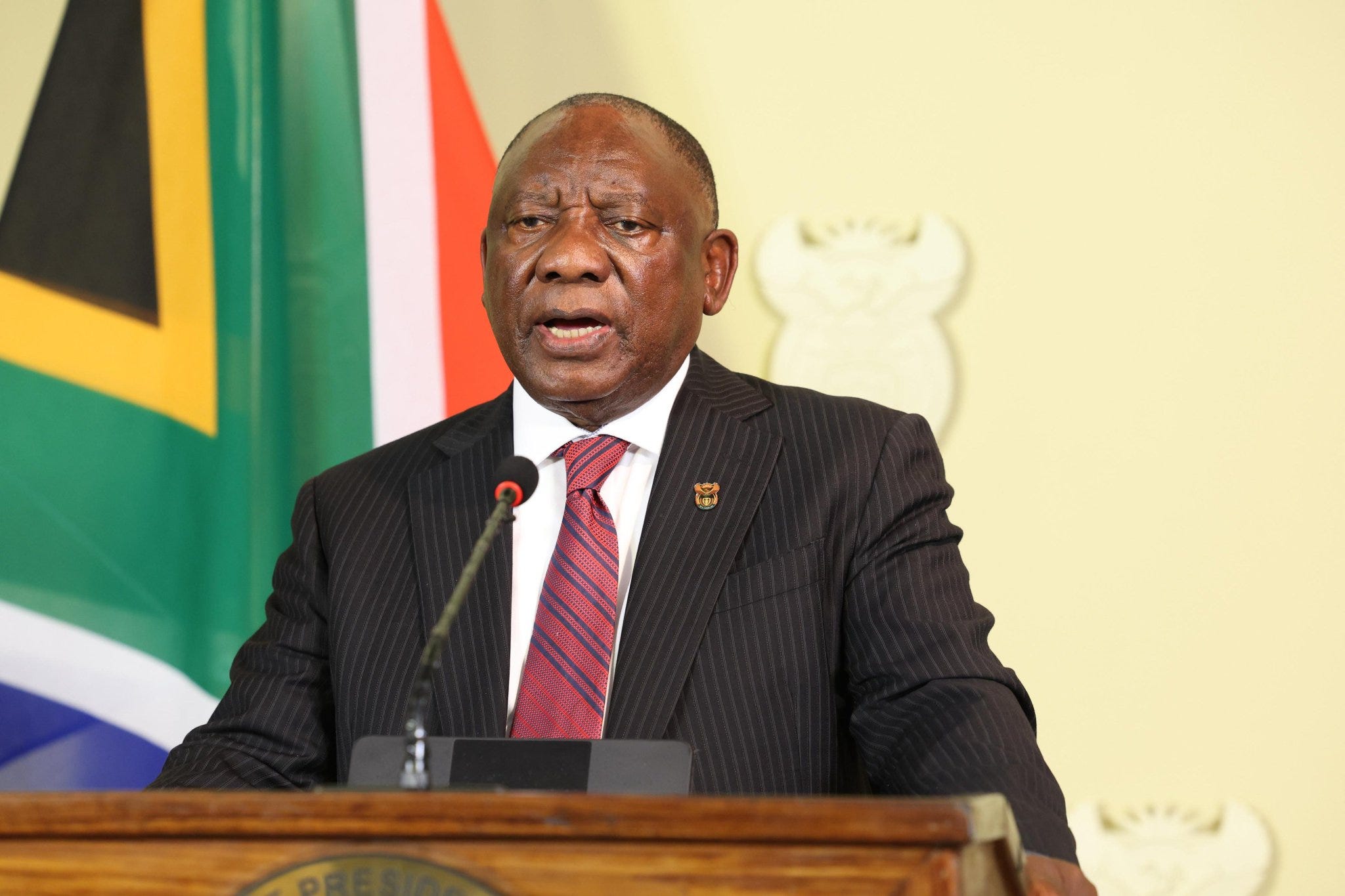
The announcement of the commission of enquiry by President Ramaphosa failed to invoke confidence and provide the necessary solution to an urgent problem. Moreover, it signified a deeper reality—that the African National Congress and President Ramaphosa are condoners of corruption, criminality, and lawlessness within South Africa.
On Sunday, the President, late by 37 minutes, provided a brief statement to the country announcing yet another commission of enquiry into the allegation made by General Mkwanazi a week earlier. In the same announcement, he placed Minister of Police Senzo Mchunu on special leave and announced Firoz Cachalia as acting Minister of Police come August 1st.
In the interim, Minister Gwede Mantashe will be acting Minister of Police. An implicated politician mentioned in state capture taking over an already politicised and delegitimised state entity fails to affirm South Africans’ confidence and further enforces the idea that the ANC and President Ramaphosa no longer care for how optically the country looks, and whether justice is something more than a name.
There is no denying that the announcement by President Ramaphosa was rather underwhelming. Lacking a clear timeline and any air of urgency, the president—as he has with other issues—has opted to kick the issue down the road without any of his allies having to face any legitimate consequence.
Minister Mchunu will still be in Parliament and will still do his duties as a Member of Parliament. “Comrade Senzo is a member of Parliament, he belongs to Parliament. He will attend Parliament and will perform all the duties that are expected of him to perform as a member of Parliament,” Mbalula told a media briefing on Tuesday at the party’s Luthuli House headquarters.
Furthermore, remaining a member of the African National Congress National Executive Committee, it appears as though there are no consequences for being implicated in crime when it comes to ANC officials. It affirms the fact that the ANC only uses state institutions and resources to remove political opponents, rather than as a means of receiving justice and accountability.
More importantly, it is apparent that the promises to renew the ANC and rid it of corruption that were made by President Ramaphosa in his first term no longer bear any weight. The president has, time and time again, failed to act decisively against accused ministers and ministers who have been known to lie to Parliament.
Minister of Police Mchunu in Parliament denied knowing Brown Mogotsi. Later, after the allegations came out, he recognised him as a comrade but not an associate—a grey area which is hard to clarify in terms of what the nature of their relationship was.
Similarly, Minister of Higher Education Nobuhle Nkabane was accused of lying to Parliament about an “independent panel” who approved the political appointments of Sector Education and Training Authority (Seta) board chairpersons. There have yet to be real consequences for actions.
The other opposition parties calling for accountability and the Democratic Alliance placed criminal charges against both Minister Senzo Mchunu and Nobuhle Nkabane. It is very apparent that President Ramaphosa turns a blind eye to the ANC in ways that he is unwilling to do to other party officials within his cabinet.
Former Deputy Minister Andrew Whitfield was removed for an unsanctioned trip to the United States—absent of a commission of enquiry or criminal charges or probes by Parliament. The president showed that he has the capacity to act swiftly when he wants to and when there is pressure politically from his party. So why can he not be the same with ANC officials?
The EFF was “appalled” by the decision to place him on special leave, which means he keeps his staff and continues to receive a ministerial salary that South African taxpayers will fund. It was seen as a “cowardly deflection, designed to shield” Mchunu.
Worse off, the commission is going to be seen as another wasteful expenditure of state resources. The Zondo Commission, taking up more than a billion Rand, has yet to lead to active prosecution. The reason being is that the same infiltrated, politicised policing system that exists is meant to execute the commission’s suggestions. It lacks the legal binding ability to actively get accountability; at most, it provides light to what is already known and, much of the time, exposed by the South African media.
The Good party recognised, though the commission is well-intentioned, that it is “too slow, too cumbersome, too costly.” Parliamentary Committees are also looking into the allegations. State resources will be thrown at problems without a clear timeline or outcome that will lead to reaffirming the trust of South Africans in what is becoming a failing state captured by corrupted officials.
The President himself has not absconded from being part of the officials who have engaged in illegitimate practices. Even as much as the media and the state continue to bury the issue of Phala Phala, the president used state resources to cover up irregularities in trying to hide the theft of $4m (£3.25m) in cash at his game farm in the north-eastern Limpopo province. There has been an unwillingness to take accountability.
Moreover, it cannot go unstated that the President was the Deputy President of the country under President Zuma when state capture was most rampant. Yet, at every turn and every moment, he has found ways to avoid accounting for his role in either aiding or hiding what had occurred during those years. This is not to say the president himself was involved in corruption, but rather that he had the power and capacity to expose much more and ensure accountability was brought to the country much earlier.
However, some hold the belief the commission of enquiry was the best option for South Africa. Former EFF member Mbuyiseni Ndlozi argued, “He acted decisively,” emphasizing the separation of power in a democracy. “In a democracy, in any just world, a president can't find anyone guilty. It's correct for him to set up a judicial commission of inquiry with a judge and strict time frame. This is proper.”
It fails to address that there is still a need for the same infiltrated and obstructed state institution to fulfill the suggestions of the commission. There appears to be a temporary solution to a broken system. There is little being done to fix the country.
This moment—the president had the opportunity to act decisively and enforce some consequences on his party that has emptied the state’s resources for personal gains for years. To actively stand up to corruption and stand with whistleblowers who aim to bring accountability and justice to the fore. He failed.
Now more than ever, as a country, there has to be a larger question for President Ramaphosa—and that is beyond failing in this moment, has he failed us as a country? Does he truly represent a continuation of a system of old, rather than the renewal that he once promised?