

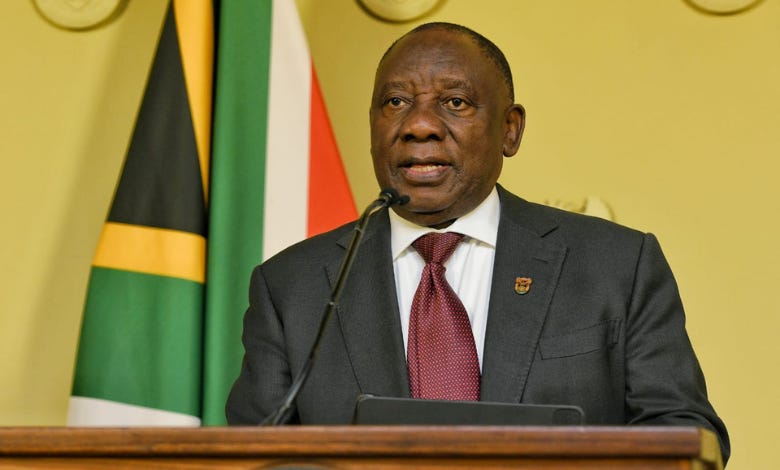
President Ramaphosa continues to affirm the power of the presidency while the country focuses on the formation of a new cabinet. With the removal of the Public Enterprises Department and the shifting of the Public Investment Corporation (PIC) into the presidency, President Ramaphosa has assumed considerable power over the South African economy.
The President of South Africa has the capacity to veto or pass legislative decisions made and agreed upon by Parliament. This means the President can pass bills and laws that will benefit his interests in the private sector, as he will be able to pass legislation that boosts profits and encourages more foreign direct investment into South Africa. With new oversight over the PIC and State-Owned Enterprises (SOEs), the President can fulfill his own incentives without disruption from any political parties.
The PIC currently holds 10% of the Johannesburg Stock Exchange (JSE). “PIC’s clients are mostly public sector entities, which focus on the provision of social security. Among these are the Government Employees Pension Fund (GEPF), Unemployment Insurance Fund (UIF), Compensation Commissioner Fund (CC), Compensation Commissioner Pension Fund (CP), and Associated Institutions Pension Fund (AIPF).” The PIC is considered one of the largest asset managers in Africa. Historically, it has been represented by the Finance Minister. There is a new structure being proposed with a new shareholding model. However, this new model lacks public influence and is appointed by the President.
It is assumed that this change resulted from the Democratic Alliance's demand for the Minister of Finance and Deputy Finance positions. This inherently meant they would have assumed control of the PIC. This would have left the President and many in the ANC without power, as they would've lost a stronghold on the economy. Thus, there was a desire to still strike a deal with the DA without handing over complete control. With an agreement finally being made, the ANC lost control of the PIC and SOEs and moved them into the presidency.
The justification for the move of both SOEs and the PIC into the presidency was to increase the effectiveness of the executive and to ensure that there would be “economic benefits from the SOEs doing joint procurement.” However, this was not in 2024 but rather was mentioned on March 9, 2023. This meant there was always a desire for President Ramaphosa to gain a stronghold on the economy and to strengthen the power of the Presidency.
So, there is a question about the genuineness of the President because of his strategic brilliance. Cementing himself in his role ensures that GNU members will not support a vote of no confidence against him. Now, having control of all the major industries, such as electricity through Eskom and railways through Transnet, and being able to appoint shareholders in a new structure which is yet to be seen, the President has a strong hand on the economy.
The fear, of course, is that the President abuses this power and places people who are likely to push his own agenda as they appoint new shareholders. Going into the future, where we potentially will experience more coalition governments, if the wrong person is given such power, they can alter the economy quite drastically. So, as much as this is brilliance for President Ramaphosa and his second term, it potentially leaves us vulnerable.
However, if President Ramaphosa is able to effectively clean up many SOEs which have been impacted by corruption and mismanagement, there is hope that with consolidated power, there will be some improvement to SOEs and their efficiency. But talks about privatization and calls for the private sector to engage significantly more and aid with the provision of basic services raise fears that the SOEs will be sold off and people will be left without cheaper government subsidies for basic services. This leaves millions of South Africans vulnerable.
So, as we navigate a new Cabinet and the new structure proposed by the Presidency, it is important to note how powerful the President is, but we must also recognize how great his political moves have been. President Ramaphosa might well be the first ANC president to complete his second term.