

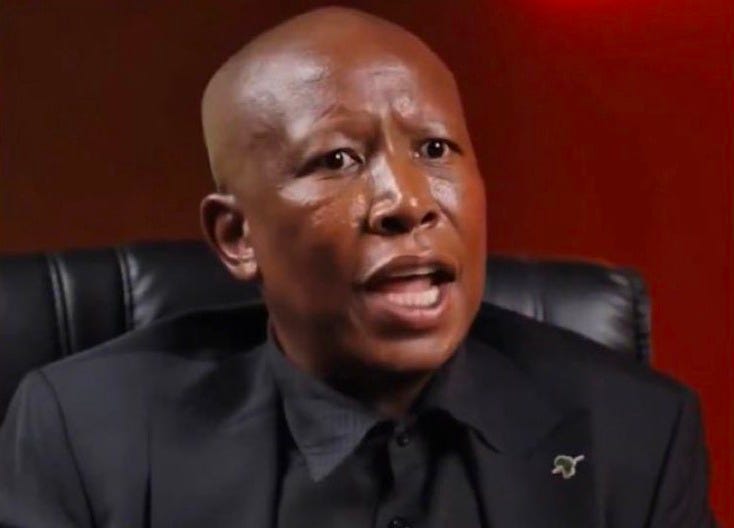
Julius Malema acclaimed two nights ago: “South Africa, Bafana Bafana must officially withdraw. SAFA must take a decision to withdraw from having anything to do with the World Cup that is taking place in America.” Has he positioned himself to be the moral voice on South African diplomacy, and could his questioning of the World Cup ask an even deeper question about South Africa’s participation?
Regarding the history of South Africa and the use of sanctions to push the apartheid government into negotiations with the ANC, those boycotts took place both economically and culturally. Particularly paying attention to the cultural boycotts, the Anti-Apartheid Movement worked with the South African Non-Racial Committee to get South Africa excluded from the 1964 Tokyo Olympics. A few years later, Commonwealth governments pledged to the 1977 Gleneagles Agreement that discouraged citizens from competing in countries where sports were organised on a racial basis. There is much written in our history of cultural boycotts.
Now it puts into question South Africa’s stance, but also action, against a country that has violated international law. In the capture of former Venezuelan President Nicolás Maduro Moros, “a lot of countries refused to trade with South Africa because it was violating human rights, it was violating international law.” Furthermore, with the United States Immigration and Customs Enforcement arresting American citizens, and in one instance killing a woman, Renée Nicole Good, there is a clear violation and moral stance that South Africa is to take if it intends to stay in line with its stance on Israel-Palestine.
However, there is a risk and deeper question South Africa will ask. Will it be willing to deal with the reactionary politics that have surrounded President Trump’s second presidency? Already the EU and other European countries are facing the threat of tariffs regarding the Denmark dispute. South Africa leading the charge on a boycott of the World Cup would most likely come with some repercussions.
Furthermore, interrogating FIFA as an organisation that hosts the World Cup, there has been an insurmountable history of the tournament being hosted in countries known for their violation of human rights.
The last World Cup was hosted by Qatar, which employed the Kafala system that tied migrant work visas to their employers, meaning workers were dependent on them for legal residence or status in the country. They were further denied exit from the country absent their employer’s consent, allowing for an abuse of power that often played out in labour and human rights violations, including low wages, unpaid wages, arbitrary deductions, and a lack of investigation into deaths, with many being cited as “natural causes,” according to Human Rights Watch. The previous World Cup before that, hosted by Russia, saw 17 construction workers die, with many others facing labour abuses during the construction of stadiums for the 2018 World Cup, according to The New York Times. There has not been a precedent for the World Cup to be boycotted.
It now asks the question: is this time different? With the EU and Europe preparing to move toward retaliatory tariffs against the United States, South Africa may have a lot more allies if it advocates for a boycott of the World Cup on the international stage. There have been moves to recognise the State of Palestine by Western countries such as France, Luxembourg, Malta, Monaco, Andorra, and Belgium. There may be more willingness to further put pressure on the United States and push for recognition and respect of international law and human rights across the globe.
Looking more acutely at the situation, Julius Malema has once again potentially put himself in a conversation that asks wider questions about South Africa’s involvement with the United States. Absent the same actions taken by countries during their own struggles—hardship, banning, and oppression of political parties and the ANC—does the ANC follow what once was of great significance for them, or do they adapt?
Either way, Julius Malema has found a way to be relevant again. He has found a hinge point that is likely to test all the powers in South Africa.
In the Government of National Unity, it will likely bring up once again the question of who forms foreign policy in the government. Should it be a collaborative process, or should it follow the ANC, which holds the ministry? Similarly, within the ANC—already tested by disagreements about partnership with the DA in the GNU—it further asks them to test their relationship with the United States, which continues to go under strain with worsened diplomatic relations. There is much to be discussed regarding South Africa and whether it is a country that takes action into word.
It is unclear to truly say where South Africa and the world will conclude on the upcoming World Cup. Geopolitics continue to shift. Strategies remain forever changing. This will be a hard discussion for South Africa and may call into question if the country is truly a principled non-aligned country that is the moral compass of the world.
For Julius Malema, this moment may once again give birth to a different voice that speaks both to those at home and abroad. This may be a more active respondent outside of government, truly trying to make the government account for its policy.
Does it truly put into question the slogan that “We will not be bullied” into a conversation that requires deeper nuance and introspection into how South Africa acts on the global stage, or will this be a conversation left to X users, political theorists, and commentators who question every political decision?
Only time will tell.