

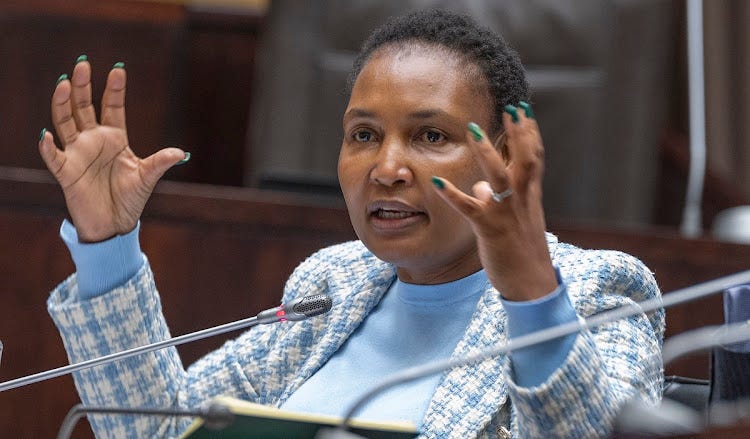
Corruption and justice, two systems that are inseparable, often go hand in hand. Corruption does not occur in the absence of justice, nor is justice pursued without a crime, particularly corruption. Most recently, the two intersected in the case involving Minister of Justice Thembi Simelane.
“Simelane’s loan, received in 2016 while she was mayor of Polokwane, was linked to Gundo Wealth Solutions, a company involved in the VBS scandal. At the time, the Polokwane municipality unlawfully invested R349 million in VBS,” according to *News24*. Simelane was the beneficiary of a loan that was neither repaid nor properly filed.
However, when called before the justice commission, she claimed her loan was legitimate and had been repaid in full. Interestingly, she did not acknowledge a conflict of interest, despite her oversight of the National Prosecuting Authority (NPA), which she supervises in her role as Minister of Justice. Nonetheless, pressure from political parties such as ActionSA, the Democratic Alliance, and the Freedom Front Plus continues to mount, calling for Simelane's resignation.
Now, with Minister Simelane standing at a crossroads, she remains in her position while bureaucratic processes continue to investigate the degree of guilt, if any, that she may bear. Furthermore, the discussion of consequences has become increasingly paramount, as the African National Congress (ANC) has stated that President Cyril Ramaphosa has the final say on how corruption within the cabinet is addressed.
This case raises an important question: Is there a need for an independent prosecution and investigation entity? Currently, with the NPA being overseen by the justice minister, it is easy for the minister to influence the agenda and decide who should face the consequences of justice. More concerning, they have the ability to obscure justice, especially when someone close to them is implicated. In the worst case, they may be incentivized to allow corruption to occur without consequence.
The issue is that corruption, though often thought of as an individual act, is actually a systemic problem. Corruption requires a group of people willing to undermine the law and exploit loopholes to benefit themselves at the expense of citizens. It would rarely be effective if just one person attempted to alter laws or steal from the state. Once entrenched, it requires a reset and actionable consequences.
With the establishment of the Government of National Unity (GNU), it was expected that there would be greater accountability and a harsher stance on corruption. Yet, in this case, even though the allegations are serious, justice continues to be obscured and undervalued for the benefit of a few. The perception of a failed state, where justice is merely a suggestion, becomes increasingly apparent when those found guilty of corruption are left to their own devices.
Already, numerous Members of Parliament with histories of using state funds for personal gain have been sworn in. They vow to uphold the Constitution and the rule of law, yet their track records suggest otherwise.
South Africa has a corruption issue, and that fact is deeply embedded within the system. There is a need for swift action and genuine renewal—not the kind promised by the ANC, but one that enforces legislation, takes decisive action, and delivers consequences to those who continue to treat the state as their personal piggy bank.
The promise of renewal, particularly within the ANC, has been reiterated for the past decade. Yet, as former president Thabo Mbeki stated, this renewal, which they continue to promise, “has not happened."