

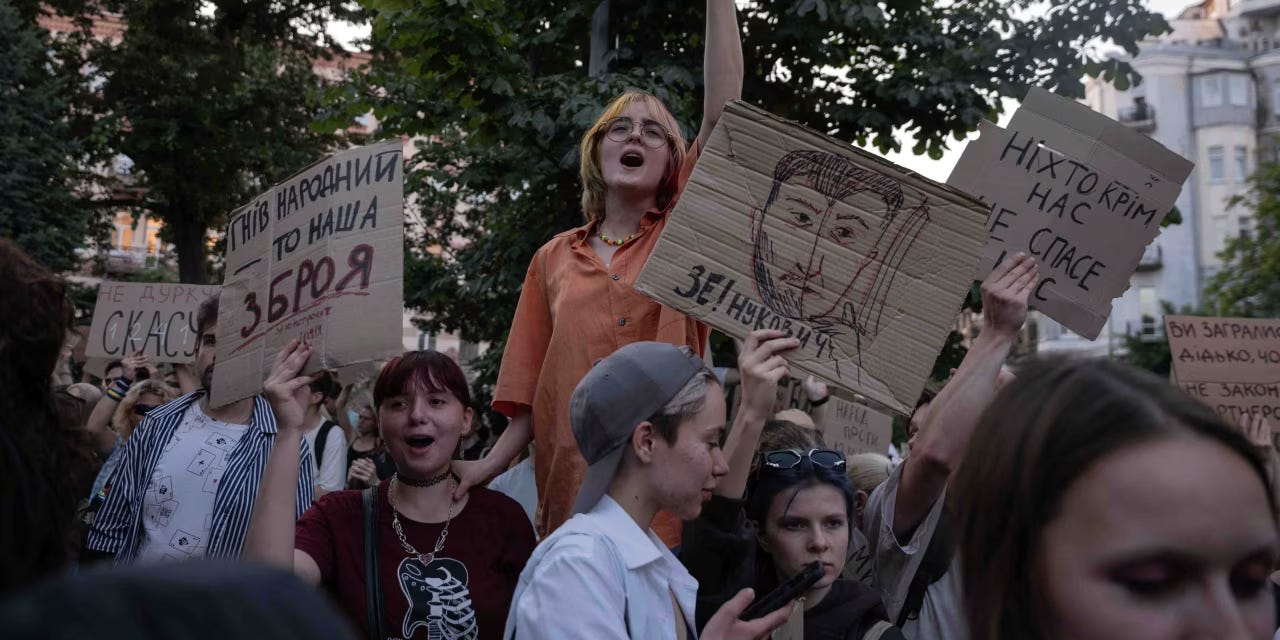
In South Africa, there is much to be learned from young people who took to the streets and forced the government to overturn a decision that led to anti-corruption agencies losing their independence. It spoke to deep discontent for the history of corruption that plagued much of the years in the Soviet Union and the day-to-day life of many Ukrainians still today.
It goes without saying that unpopular government decisions occur in South Africa. Most recently, the establishment of the Madlanga Commission of Enquiry after damning allegations by General Mkhwanazi, which implicated various state agencies and politicians who are all meant to uphold the Constitution, failed to do so. The allegations led to the mobilisation to disband the political task team that was uncovering political killings and criminal syndicates in South Africa.
Parallel with the Ukrainian government, which recently passed legislation that would curb the National Anti-Corruption Bureau (NABU), which had implicated ten Members of Parliament, young Ukrainians were able to recognise another attempt to undermine any accountability of an independent agency.
A young 23-year-old working in green energy, Zinaida Averina, took to the streets and mobilised a cardboard protest devoid of political claims and the desire for politicians to make sense of the opportune moment—allowing for the citizens to encourage and force an overturning of a controversial law. Marking a sign that young people can and should take care of their future and their country.
Through organising and establishing a commitment to constantly put pressure on the government, there was nowhere to turn for President Volodymyr Zelenskyy but to face the growing pressure placed on his administration.
Turning to South Africa, where corruption has become synonymous with daily news and accountability has been limited to nothing but words said in speeches and on paper. With countless failed attempts to get actionable, legitimate accountability where corrupt officials face consequences larger than smear campaigns. It reminded me that there is a capacity to turn things around.
Former Chief Justice Raymond Zondo spoke to the Sunday Times, indicating his disappointment in swearing in implicated officials during the 7th Administration, after a lengthy and timely process in the Zondo Commission which exposed the extent of state capture. That occurred on the backdrop of the decommissioning of the Scorpions and the strategic attempt to gut out state institutions such as SARS. This indicated a degree of disappointment but also acceptance of the state of South Africa as it stands now. However, it does not always have to be that way.
In a country such as Ukraine, where corruption, which has continued as a legacy of the Soviet Union, penetrated and is still apparent—through the following examples: gestures such as putting a banknote in a politician's coat pocket to get an operation brought forward, paying at a driving school to get your driving licence, or now, when we are in the middle of a war and there are so many soldiers on the front line, there is also the fact of paying—and they pay thousands of dollars to obtain papers that will allow them to be discharged and go home if they are given them, or even to avoid going to the front line when they are recruited. There was an ability to ensure accountability was prioritised and remained intact at a higher level through youth organisation.
Similarly, in South Africa, there is capacity to not become accepting of the failures of state and the history and legacy of corruption, particularly at the hands of the ANC, if young people take action and actively mobilise to see the government respond.
Not in the ways that mobilisation has occurred historically. Through dedicated organisations that not only fight to be heard but begin to future-plan what South Africa they hope to embody, there is capacity to redirect the course of the country and force politics to once again become a thing of the people.
Yes, there is no denying that there is a great deal of disillusionment and lack of political participation through the vote. However, this would negate the state of mind that can be achieved.
Even in a country such as Ukraine, that is actively engaged in war with its neighbour Russia, young people who are in some of the most strenuous conditions ensured that there was no limitation or obstacle but rather opted to push on and ensure that there was action.
It cannot be that in South Africa, apathy and economic conditions become the limitation to taking action. For that would negate our history, where the Black populace across the country were disadvantaged to the worst extent of oppression. Yet they continued to fight.
Liberation in our country did not take place absent struggle or absent hardship. Rather, liberation took place in the ability to see the common belief that every person born to this nation ought to have the right to vote and legitimate legal representation and human rights.
South Africa, though now feeling worse than ever before, does not mean that young people ought to sit back and become victims of their circumstances but rather become active fighters and activists to a situation that can no longer be allowed to decline.
But beyond that, at this moment where political parties will once again be vying for the vote in Local Government Elections—for young people, it should not be them who sell to us what the country looks like, but rather us telling them what we hope to see.
The reality of the matter is that South Africa has been without a vision since the advent of liberation. Former President Mbeki tried to set us on the right path but still had many shortfalls. But within that, his presidency was not slogans absent of belief and plan, but one that actively encouraged policy and political engagement.
The fight for South Africa will not be an easy one; it will not be a quick one. But it is one that is necessary. One that needs to be led not by the past, but by the future. One where we promote accountability, participation, and representation for all who encompass the land of South Africa.
It is time young South Africans learn from their committed and active members in countries such as Kenya, the United States, and Ukraine, and not just fight for now but for their future—to really dream of a nation we can all call home.
A nation devoid of prejudice, inequality, and racial injustice. One where every single person can trust that there is more for themselves than just their own empowerment, but rather a collective transformation that is inclusive of the most vulnerable and the most desolate communities.
South Africa is home. There is no other choice but to make it better and not wait for political parties to lead the way, but rather to lead the way for ourselves and turn around what seems like a country without vision and without a plan.
As Nelson Mandela said, “It always seems impossible until it’s done.” So like the young people of Ukraine, let’s do something about the state of the country.