

Recently, it has been horrid watching the extent of violence and denial of humanity that has occurred in the country, with both an increase in xenophobia and the recent e-hailing killing that occurred in Soweto.
First, it is important to outline that South Africa at the moment is bearing the weight of a state in stagnation, absent of a clear path both politically and economically on where the country should be and what that should look like.
At most, the National Dialogue — in its earliest ideology of social compact mentioned by President Ramaphosa in 2022 — was rooted in allowing South Africa to set on that journey. However, three years later, the initial engagement lacked the buy-in of the nation and raised questions of legitimacy in the absence of the legacy foundations and key figures such as former President Mbeki.
South Africa remains a country deeply yearning for improvement that leads to material change in its environment and lifestyle. This extreme level of need has been more emphasised in the dire demand for basic services as state infrastructure struggles to function and provide for an ever-demanding population that continues to increase yearly at around 1.3%.
This is in the background of an economy that is not growing sufficiently to maintain a middle class and provide individuals with the capacity to seek opportunities and sustainable work — displacing many in the youth. The country is in a very dark place, grappling with COVID inflation and, in the future, the American tariffs if there is no deal struck between the two nations. South Africa is left without many ways out that are quick and effective.
Within that, there should never be a point where the country turns on itself and makes the enemy one from within. When times get tough and there is less ability for everyone to guarantee a job or even an opportunity in the economy, there is an innate desire to retaliate, many times ending violently or in ways that place the country's humanitarian stance into question.
Secondly, looking more deeply into the violence and the evidence of xenophobia, it is apparent that communities which once co-existed are now being forced to compete for a shrinking income pool and a ballooning economy.
Moreover, specifically on resources extending to education and health care, the active attempts to deny and remove people by Operation Dudula raise questions on whether or not the country will stand for its own constitutionalism.
This is not to ignore that the country was plagued into this situation: a country derailed by state capture, followed by a pandemic and a global economy that slowed to recover. There was a lot that came in a short span of South Africa’s democracy.
More so now, the country is grappling with the reality that — though at the hands of the ANC — corruption is also embedded in the thinking of many South Africans. Corruption has become the procedure of daily life, engrained at every level of living.
Particularly in engagements such as obtaining licensing, interactions with law enforcement, and displays by those in power. It is as though corruption has become this undefeatable ideology in South Africa, where complacency is the resolution and corruption is an aspiration — to be as those who succeeded in former years.
Additionally, the state is unable to clearly define how deep the rot goes and how influenced independent institutions — those the nation ought to put its trust in — have become. Already plagued by another slow commission of inquiry, absent anything other than legal and presidential suggestions similar to state capture, there is an unsettled nation that believes it ought to trust only those who are familiar and remove those who are not.
The violence that led to the killing of a young South African who was seeking an opportunity through e-hailing services sparked a degree of anger that is worrisome, as taxi and e-hailing services are now actively competing in a decreasing income base and shrinking economy with increased fuel prices. There is a pressing need to maximise trips and clients to maintain a sustainable life.
Within that, both communities of drivers attempt to do the same thing: get a job and provide for a family. Simply using the opportunity presented to them in a country crippled by lack of opportunity that is accessible and engaged nationwide.
Yet, these communities have opted not to co-exist. Not because of their particular dislike for each other, but because of the inherent competition presented by the economy. At its most basic level, it is the presentation of survival of the fittest, where both communities have to compete for a limited resource pool.
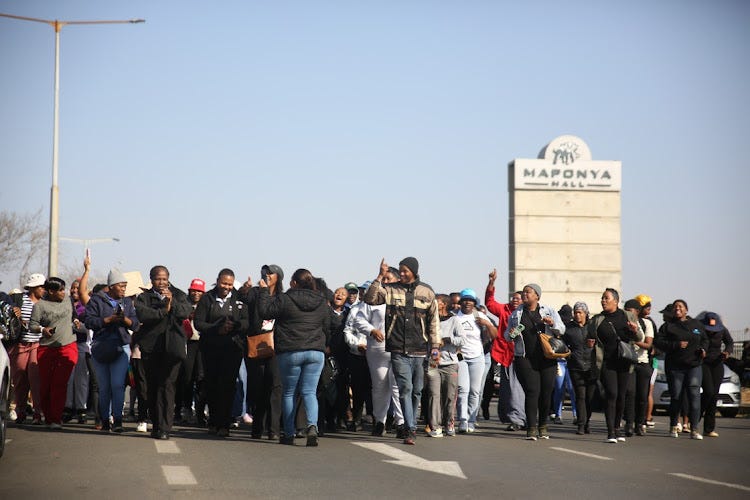
However, it did not end there. The community struck back and stood up for the safety and the need for co-existence. The community demanded safety and security and refused to allow lawlessness to take over the country. But still, that day ended with violence and a taxi on fire.
It is key to point out that both families who would have benefitted from the employment of those two entities now have nothing and must hope for other prospects. There is no discrediting the pain and suffering — simply a feeling unable to be communicated in words — that communities in South Africa are under.
Similarly, Operation Dudula’s desire to deny students from school as the Bela Bill Act takes place once again puts a nation limited in opportunities into a position of questioning everything it once could stomach in good times.
Suddenly, the state's already depleted resources are being pushed to their extremes, and a nation already overburdened faces more pressures. It is all too easy to push that blame onto the neighbour, but to what end?
In the illegal immigrant jargon that has propelled South Africa’s xenophobia — which has peaked and troughed at different intensities — there is extreme overconflation and a lack of understanding of the nuance between a refugee and an illegal immigrant.
Within this, the need to verify and affirm the difference between a South African, a child born into South Africa, a person raised in South Africa, and a person who moved to South Africa begs the question: from where does someone derive their identity?
By no means should it be believed that the nation, in its current struggle, has the capacity to reckon with that question, let alone look beyond its own struggles. But it does not mean that the nation should shake down and strip people to a point where society feels dignified in actively playing judge, jury, and justice.
A story was once told to me of a man from the Congo who expressed, with great despair, how difficult it is being a refugee. He, like many, had not lost his desire for peace and economic prosperity to which he could one day return.
He expressed how much of this is not a choice and, like many, had to deal with the complexities and improbabilities of life. Much of his life also presents its own stresses, as does any human’s regardless of nationality.
However, the nation still turns on those who make up South Africa, rooted in the belief that South Africa belongs to all who live in it. It is very much an ideal, but one that should allow the nation to actively move towards it rather than shift the blame to the most tangible neighbour.
The reality is that all parties suffer; they all lack the safety, security, and ability to fully believe in their nation and to be led by their government — one where functional basic services are accessible and reliable. Yet neither one of those communities caused the problem.
It is difficult to discredit the pain many people go through as they lose family members, friends, and loved ones due to a state lacking the capacity to provide health care to the nation. Nor is there an ability to flee a country due to the state and nature of the violence that it is in.
On both ends, both communities have a story — one deeply rooted in the need for change. One that is positive, one that appears in the households of millions, and one where dreams can be actualised. But that still remains idealistic.
However, it is just those ideologies and ideals that get a nation to change how it engages with one another — how much togetherness is allowed in times of suffering and pain, and what makes up a community in everyone’s respective eyes. Who is the in-group, and who is the out-group? But that remains dangerous.
It opens spaces where hatred manifests in violence that leads not to the improvement of either side, but deterioration on both sides. Both sides suffer the consequences, both sides live with the pain, and the problem remains.
Solutions are rooted in communities. There are, of course, times of both struggle and success led by those who aspire to take the mantle and steer the ship. However, it is not done absent of people — absent of the voices of all those who actively partake and make that reality.
Instead of being absent, a nation with a clear direction and leadership, if possible, may be one that does not turn on itself and make itself the enemy, but one that calls on society’s own ability to create a better society.
Looking at the state of the nation, the pessimist view is that it will get much worse before it gets better. The optimists may believe that the nation will recover and grow from this experience as soon as mature leadership arises. At the end of the day, this is something the nation will face together at varying degrees of pain — but let that not mean that everyone forgoes their respect for humanity, dignity, and human rights.
This marks a reminder that collectively the nation is suffering everywhere. The pain for each group is unique, but should not overshadow or deny other groups from expressing their pain. There is no capacity to pick apart differences between us, but rather to find the things that allow for a little light, hope, and love to be found.
As a nation that once found commonality in neighbouring states’ struggles, and embodied the ideals of Pan-Africanism and pro-peace, let us not forget where we came from — a history deeply rooted in cooperation, pragmatism, and togetherness that extends well beyond our borders.
Even in this moment of struggle, hopelessness, and plight, let us not forget that the enemy is not each other, but rather ineffective, unresponsive, and leaderless governments that opt for self-enrichment rather than governance.
Rather than assigning blame, let us think about how the nation can create positive solutions — ones that work for everyone and cause us not to be threatened by differences, but rather appreciative of the pain, journey, and torment every single person in South Africa faces.