

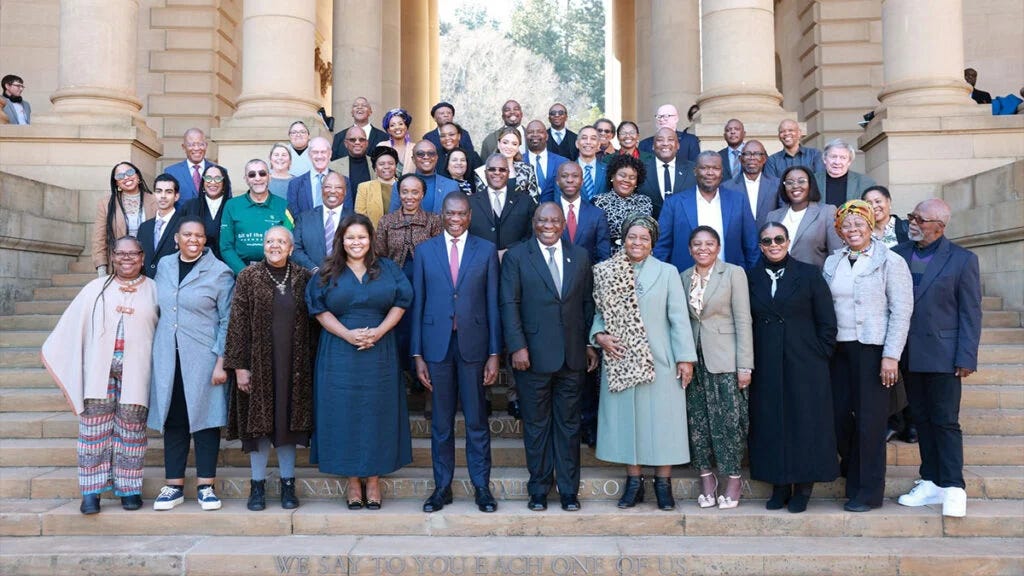
A National Dialogue absent of civil society and the voice of South Africans from the most impacted communities is yet another display of a rubber-stamping event for the Ramaphosa administration to claim to be doing something, when in reality it is doing nothing.
The pulling out of the legacy foundations — Thabo Mbeki Foundation, the Luthuli Foundation, Tutu Foundation and the other legacy foundations — signified that South Africa no longer has the legitimacy necessary to call this a dialogue for the people and by the people.
It is evident that South Africans, throughout the build-up to the opening convention that takes place tomorrow on Friday, August 15th, have denounced the R700 million price tag that has come with the dialogue.
Already a nation disillusioned by a government plagued by inaction — that fails to get action or accountability when presented with issues, evidence, and statistics — once again has opted to lead South Africa into a process without a clear mandate and outcome.
Gathering 31 eminent individuals in a nation of people who have been successful and influential South Africans within the country, there is an apparent lack of the average day South African who lives in the depths of society, absent of influence, plagued by service delivery.
Furthermore, the absence of political parties — those being the EFF, MKP, DA, FF+, and ActionSA — further displays a lack of representation of even the political spectrum that is South Africa. It further enhances the belief that this is an ANC event, run by the Presidency, absent of the necessary representation to allow dialogue to be valuable and occur.
The reality of the situation is that dialogue provides validity when civil society is given a space and place to air out its grievances truthfully and honestly. At the moment, this overly curtailed and exclusive event is for the elite to feel as though they are contributing to solving South Africa's issues — when in reality, they are not.
South Africa, faced with water issues, electricity issues, education issues, healthcare issues and other issues, is not keen to talk but in dire need of action. The weird desire for South Africa to discuss and further talk about issues that have been highlighted on a daily basis by media outlets throughout the country does not need more perspective on the issues.
Looking more honestly, the entire political system of our democracy is a conversation — one where, on a regular basis, the country gets to use its vote and actively express its discontent for one party and its favour for another. The country spoke at the end of the election and clearly allowed a way for new political parties.
The country continues to speak through protests, where they call for an active response to their situation. They take to the streets not purely to demonstrate, but rather to be heard and recognised within their pain and suffering.
This dialogue will highlight and embody much of South Africa’s — and President Ramaphosa's — problems. That a politician provided with a mandate to govern continues to opt to talk and delay solving issues, rather than putting together plans to change the path our country is on.
Already, the country for over a year has been forced to watch the government fail to govern, fail to talk to one another, and fail to set South Africa on a new path. The National Dialogue is only likely to be much the same.
Worst of all, it won't be for all South Africans. It does not represent all South Africans but rather represents a president who is unwilling to hear the concerns of the people. The legacy foundations called for a delay in the dialogue in hopes of having a more transparent process, and civil society-led means there is a need to reassess.
But in that same vein, it should not be that the country is given another arbitrary alternative that is not rooted in pragmatism. It is unclear what a civil society-led dialogue looks like if there is no plan to put the people at the forefront of that discussion.
South Africa, at the moment, across the board, needs not dialogue but to come together and organise — in civil society, in government, and business as a whole — to gear South Africa to an actionable plan that calls on all of South Africa to play their part in moving the country forward.
The dream of South Africa was one where many South Africans had to dream and had to believe that there is a future where everyone could live together. Now, South Africa is in a moment where apathy and despair feel more palpable than ever — it is important the country does not lose sight of that ability.
At every moment throughout our history, it took taking to the streets, organising in secret, and writing policies for the future and dream that was a nation that could be liberated. In that same vein, now, where all seems impossible, the country ought not lose sight of what can be possible — but must fight what appears to be an obstacle or another delay to getting real change in this country.
South Africa has cried about its problems, screamed as though a nation in mourning, yet those calls for action and change have fallen on deaf ears. So what, then, should the country make of dialogue so many have already opted not to listen to?