

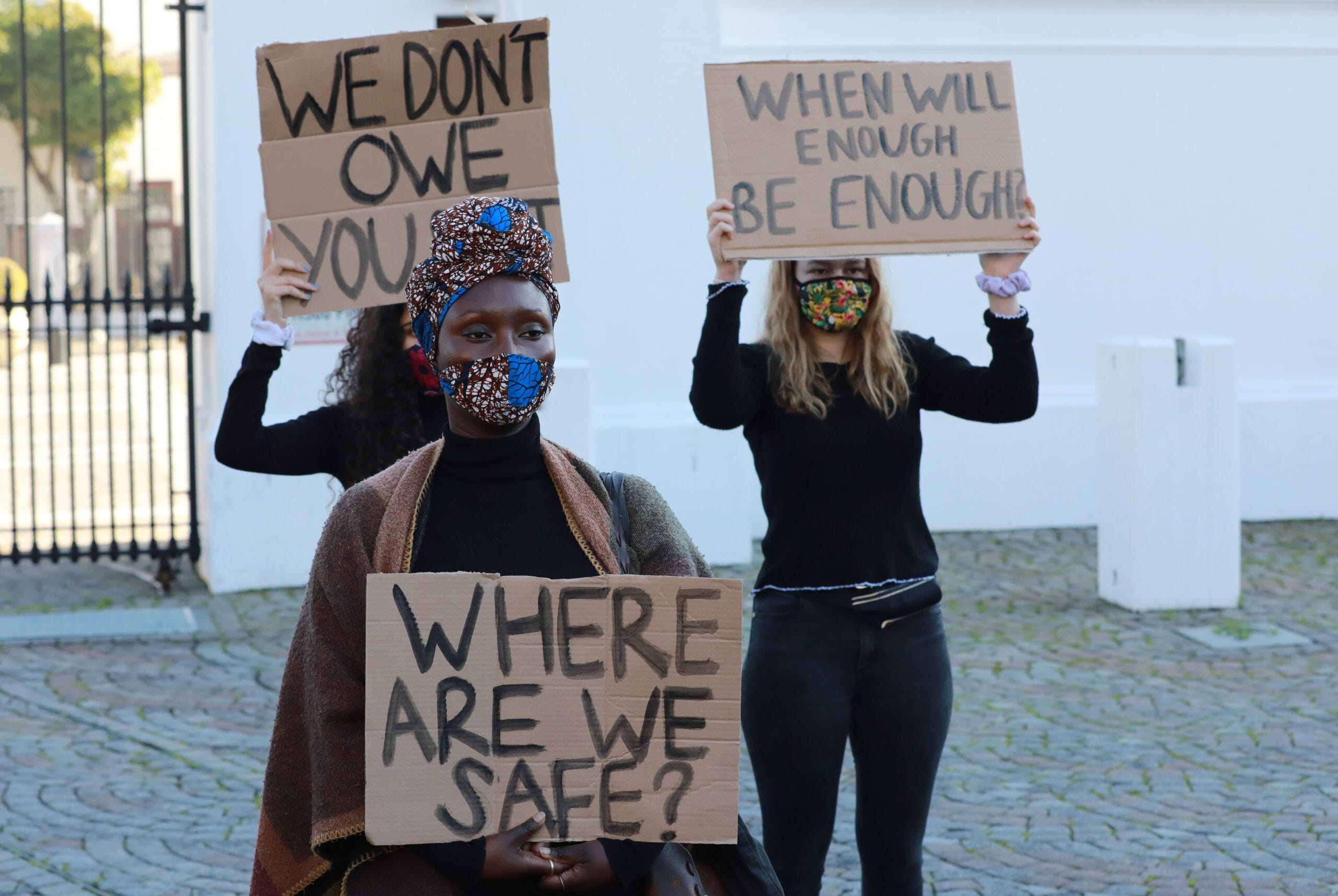
Another name. Another face. Another woman taken.
In South Africa, it is not a matter of if there will be another Gender-Based Violence and Femicide (GBVF) case this week – it’s a matter of when. Women For Change frequently reports cases of GBV, and the nation’s silence is deafening. What does it mean to be a woman in this country where your safety is never guaranteed, even in your own home?
In South Africa, GBVF is not an isolated incident. It is a constant nightmare. Everyday, women scroll through headlines that feel like warnings. Women For Change, an organisation advocating for women’s rights, has reported new GBVF cases frequently in recent months. The organisation has called on President Cyril Ramaphosa to declare GBVF a national disaster – a call that reflects the urgency of a crisis that has already claimed far too many lives.
According to Stats SA 2023, South Africa has one of the highest femicide rates in the world – five times the global average. According to the South African Medical Research Council (SAMRC), a woman is killed every six hours in South Africa, often by a family member or intimate partner. That is approximately 1,460 women every year, which serves as a chilling reminder of the violence that defines women’s everyday reality in this country. Behind each number is a person, a stolen future, a grieving family, a shattered community. These acts of violence are not sporadic, contained occurrences, but are deeply ingrained in a patriarchal system that normalises perpetual violence against women.
In 2006, South Africa watched as Fezeka Khuzwayo, publically known as “Khwezi”, stood in court and accused the then-Deputy President Jacob Zuma of rape. The trial was not just a legal proceeding, but it became a battleground for the soul of the nation grappling with its attitudes towards gender, violence, and power. They called her Khwezi. They vilified her in the streets while she was on the witness stand. And when she fled the country in fear, the country turned the page. Fezeka Kuzwayo didn’t just stand trail as a rape victim – she stood trial for daring to speak out against power in a country that insists it protects women. But nineteen years later, her story is the reality of many women. In fact, Fezeka’s story is an example of why many survivors do not even report their assaults. And some don’t even make it out alive.
Yet, even in the face of relentless violence, the state has not responded with the urgency this crisis demands. Declaring GBVF a national disaster would be more than a policy decision. It would be symbolic – a public acknowledgement that the lives of South African women and girls matter. It would unlock emergency funding, establish specialised task forces, prioritise survivor-centred services and prevention education, and catalyse a coordinated multi-sector response that includes policing, justice, and health services. More importantly, it would signal a national shift: that GBV is not a “women’s issue” but a crisis of citizenship, governance, and human rights.
Symbolically, such a declaration by the country would affirm what millions of women already know: that we are living in a state of emergency. We have been for years. It would tell every survivor that her pain is not invisible. That her safety is not negotiable. And it would challenge every citizen, particularly the youth, to rise against a culture of silence, complicity, and normalisation.
The myth that gender-based violence exists only in the shadows or in “unsafe” areas is just that: a myth. GBVF cuts across race, class, gender, age, and location. Chera‑Lee le Roux is an example of this. On the evening of 14 November 2024, 27-year-old Chera-Lee, used an Uber to get home – what should have been a safe, routine trip turned bad, when four men reportedly forced their way into the vehicle and attempted to rape her while the driver did nothing to help. She survived and reported the crime to the South African Police Service (SAPS), who confirmed the attack through Close Circuit Television (CCTV) footage – but weeks later, the case remained stalled. There reportedly was no compensation or assistance from Uber and the government treated it as a low-priority personal complaint, not as it was: a national emergency.
While there has been a sensationalisation of a so-called “white genocide” of Afrikaner farmers, it is important that we clarify the truth: there is no statistically substantiated genocide against white South Africans. What is happening, and has been for decades, is a relentless, widespread, and under-acknowledged war on women. This is the real genocide. It is slow. It is personal. And it is deadly.
Because, to be a woman in South Africa is to live in constant negotiation with fear. From checking the backseat before driving, to sending live locations to friends, to being taught to lower your voice and be nice when confronting a man – these are not quirks of femininity, but survival strategies. Yet, GBVF is not just a woman’s issue. It is a societal issue. It is a human issue. And it requires everyone, especially men and boys, to be part of the solution.
This is not just a hopeless fight. Around the country, young activists, students, and community leaders are pushing back. Social media has become a powerful tool to raise awareness, mobalise protests, and demand justice. Campaigns like #AmINext, #JusticeforUyinene and #JusticeforCwecwe has forced the nation to recon with its violence – even if temporarily. But we cannot afford to let these moments pass as mere hashtags. We need more than state action. We need a generation that refuses to be silent. We need young people to organise, to speak up, to challenge harmful norms in their schools, relationships, and communities.
To those reading this: your voice is powerful. Whether you’re posting, protesting, volunteering, or simply having difficult conversations with people around you – you are part of the change.
And to the leaders of this country: How many more?
Posted on the 23rd of June 2025
