

It cannot go without saying that uncertainty plagues politics around the world. The use of war rhetoric—defeating the enemy within, Abahambe in South Africa, and ongoing geopolitical conflicts—makes no place feel safe or provide the certainty of the home we once loved.
In South Africa, that has been felt more truly in our own politics. Many parties are dealing with infighting and disputes that end up being leaked to the press. The belief in good, genuine leadership appears to be failing around the country.
The Umkhonto weSizwe Party is dealing with leadership changes as if engaged in a world of political musical chairs. The EFF has recovered and resolved the infiltration and gutting of party leadership over the past few months. The ANC and DA constantly struggle to control the narrative around policy and budget. It appears that we have more problems than solutions.
Accompanying that is the growing belief that governance and democracy don’t work. With all the top leadership in the EFF, ANC, and MKP respectively having a history of corruption that precedes them, it seems politics will never be a clean game.
South Africa is now a country bloated with promises, left with little execution, and growing sentiments of a cry for help from civil society. We are a country geared for instability and uncertainty. Wages are low, unemployment is high, education remains inaccessible to most, and there is no solution to these pressing issues—issues that were identified at the onset of our democracy.
Yet, the discourse in the media is dominated by everything but the struggles of the people. In many ways, South African politics seems more about settling scores and gaining personal advantage than governing for the people.
This sentiment was highlighted in an interview on SMWX, where Tokyo Sexwale expressed that the leadership of substance, which dominated the 90s and early 2000s—the leadership that negotiated our freedom in South Africa—was no longer.
More interestingly, it highlighted that Nelson Mandela, Govan Mbeki, and Ahmed Kathrada were consensus leaders who led together, not alone. They were dedicated to fighting for their people with collective leadership—an idea that seems more distant than ever in South African politics.
In the current scope of South African politics, the EFF, MKP, and ANC still represent just under two-thirds of Parliament. They have the means to draft policy and find adequate solutions to the problems many South Africans face. More importantly, they can revitalize the dreams of the ANC and the belief that liberation was meant to be an additive to our people, not a negative.
Now more than ever, there is a need to set aside personal disagreements and find common ground so they can take control of the country once again.
The reality is that the EFF, ANC, and MKP are not ideologically far from one another. They represent center-left politics in South Africa. They share the same desires—to create jobs, provide education, and offer economic opportunity for all. They just disagree on the process of achieving these goals.
Instances such as now, where minority parties like the DA can wholeheartedly decide the financial situation of the country due to the majority’s unwillingness to cooperate, show that these parties have politically regressed. They find themselves unable to govern in the ways they once believed possible.
It must not be forgotten that many of these leaders were raised on the Freedom Charter and collectively worked side by side to bring about the liberation of our people. So we must ask them to do it again—this time, not for themselves, but for the people they claimed to fight for many years ago.
Without a unified front, we allow the United States to dictate how we produce policy because we are seen as fractured and weak instead of collective. We allow blame to be placed on the past and history without finding solutions. We allow our people to grow restless.
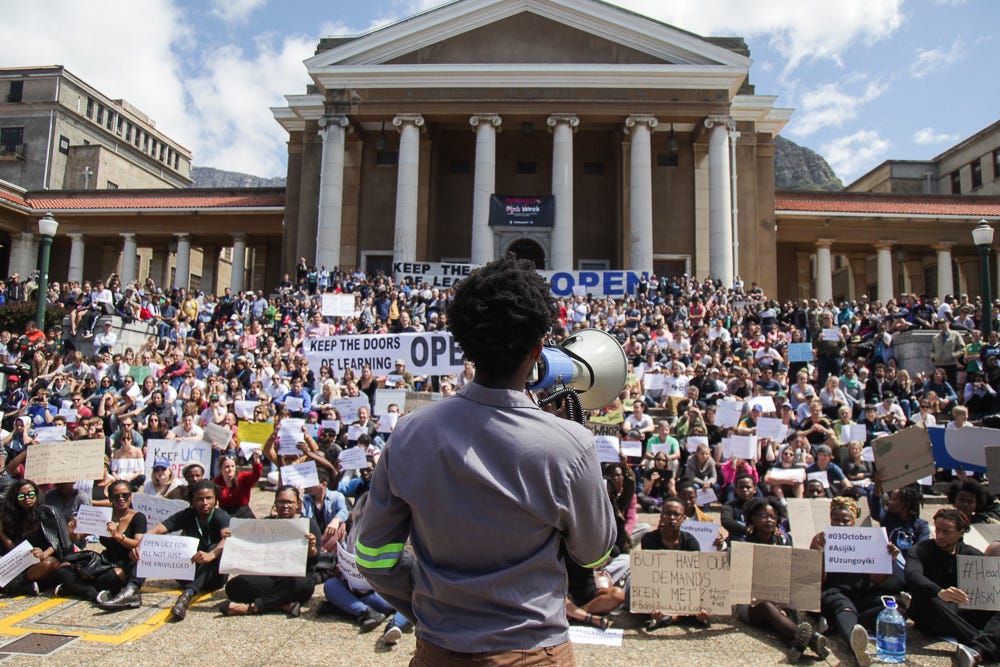
A restless population is an ungovernable population. We saw it in the mid-80s to early 90s when South Africa could no longer wait for its democracy. We witnessed some of the most violent years in our country.
Now, at a crossroads, we must not allow the bloodshed that dominated our journey to liberation to have simply been a delay in the road—a momentary pause in the process. We must ensure that it was a commitment to securing peace and justice within the country.
South Africa, now more than ever, is fractured, and the cracks are beginning to show. We need to ask our leaders to amend the situation—if not, we may no longer believe in the same rainbow.