

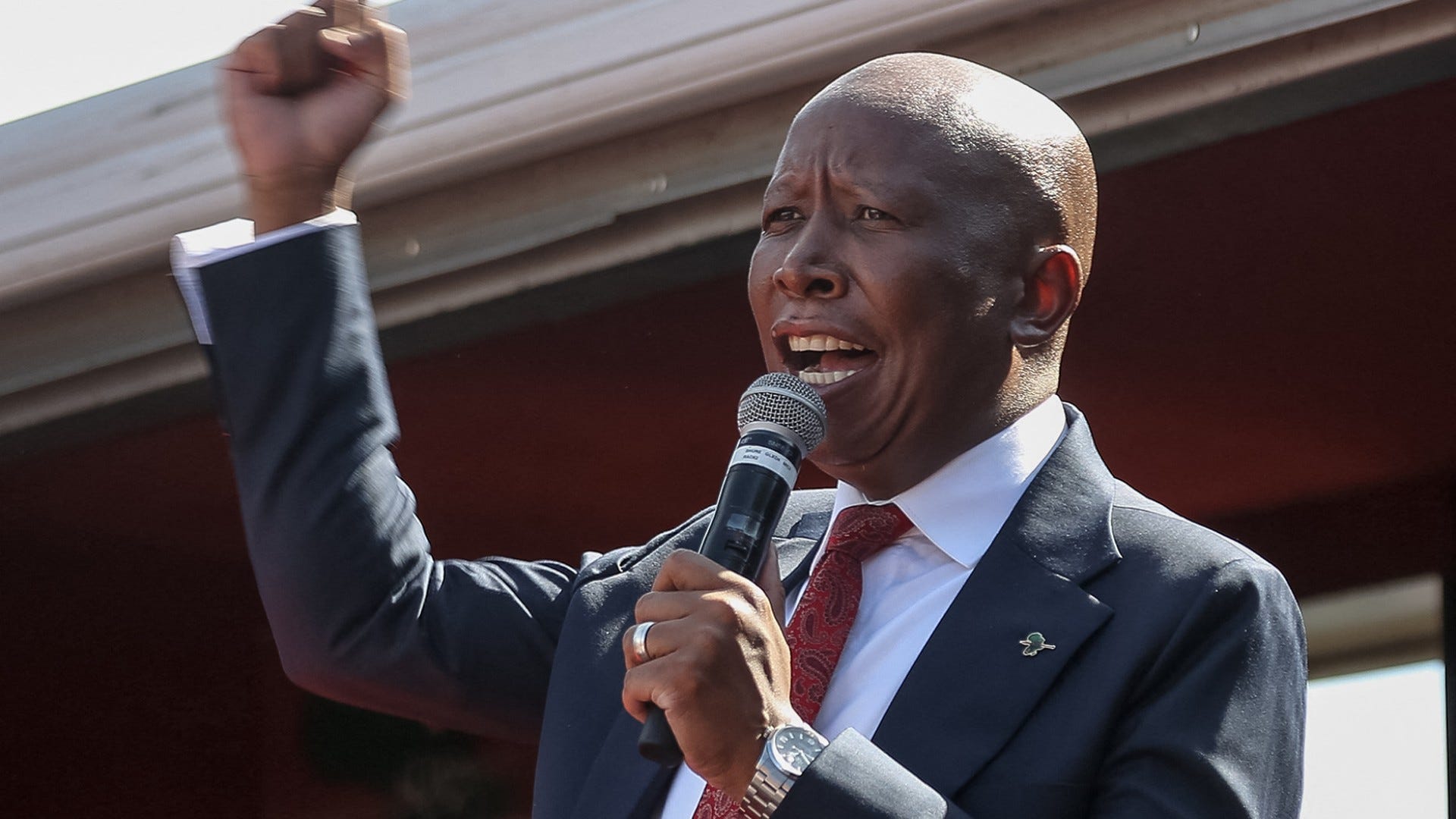
The sentencing of Julius Malema on the back end of the DA internal election will mark a moment in history — a moment of change and a moment that has changed the face of South African politics. Does it mark the end of the EFF, or does it provide the avenue for a new party with a revolutionary spirit to be birthed in the image of Julius Malema?
On 16 April, at the conclusion of the first day of the sentencing hearing, Malema outlined that, though he may no longer be a physical presence, his spirit remains: “They use us to show that whoever dares to speak truth to power must be jailed; we shall not be silenced under any circumstances. They can imprison me, but they will never imprison my ideas. They will never suppress the idea of economic freedom in our lifetime.”
This mantle is not new to South Africa; it emulates the track of many of the great and revolutionary leaders of the past, whether it be Nelson Mandela, Oliver Tambo, or Walter Sisulu, to name a few. The state detaining you was not a diminishing of your ideas, but a call for those ideas to be thought anew, revolutionised and embodied in the people and no longer in a person.
It emulates the Pan Africanist Congress, which recognised and never contested its leader in Robert Sobukwe, a revolutionary leader who declared that Africa belonged to Africa. The party remained a thorn in the side of the ANC, but died as liberation narratives dominated and their leader was laid to rest.
Malema’s imprisonment, though being a dim moment in the current light, has the potential to play out in ways that South Africa is not yet considerate of in politics. Malema will no longer be a man who is given time to speak, but rather time to think. He will become an image for the young South Africa who believe the government is an extension of the political establishment to believe less, but it will leave a man with a narrative that the system is fighting him — and he too will fight back.
The legal proceedings are far from over, and the appeals of the sentencing are likely. This is the beginning of a battle of resources versus the state in the case of Malema. But it is a battle worth taking.
In the same ways that Mkhwanazi, Cat Matlala, and other actors within the commission of enquiry have been idolised as a result of the power they hold, the aspiration they represent, and the constant battle framed in the media in South Africa as a fight between good and evil, Malema is given an opportunity to take on the state.
Even if the appeal is unsuccessful, this moment signifies that he is down but not out of politics. Malema is sentenced to five years. He will be allowed to return back to politics five years after his sentence ends. He will be a man with a story and a mission to take the space the government actively denied him — the ability to be the man for the people and the future president of this country.
However, the Economic Freedom Fighters have an opportunity to still honour the wisdom and principles of their charismatic leader, while defining the party in a manner that is truly and wholly representative of the people, the youth and the moment.
Already a party that was grappling with the decline it faced electorally, an exodus of members leaving to the uMkhonto we Sizwe party and a leader who seemed to have been tightening his grip, this potentially is the breath of fresh air the party needed.
This may be the moment, if done correctly, for the “youth” party of South Africa to be run by the youth. Already dominating university campuses and developing the political leaders of the future, the moment provides the capacity and ability for that future to be now. The EFF, truly at this moment, has the opportunity to be the movement it is hoped to be — to address the socially pressing issues that plague modern South Africa.
But it also provides a unique moment for Julius Malema to think, to redefine and realise a new identity. He is provided a new opportunity with the idea that “the most dangerous man to any government is the man who is able to think things out for himself, without regard to the prevailing superstitions and taboos.” While South Africa grapples with its national and local politics, he can regain control of his own.
It will be interesting to see how this moment, through time, will be defined — as either another rebirth or the death of Malema’s political career. As South African media tries to predict once again what the future holds for the EFF, this provides a perspective that may be more positive.
Regarding the DA shortly, this moment is rare. Either they will capture the people who continue to go without a political home, as the face of politics changes across the country, or they will face the deep reality that they are not a national party. If the ANC benefits in any way at the cost of one of the DA’s formidable enemies in the EFF and Julius Malema, it leaves them to fight only their ally in the ANC — potentially drawing much strength for the broad church which is the ANC.
The moment is going to truly test whether or not the party which is the DA — and the future of the country — lies within unity, or will once again become a battle ground where only the DA and the ANC are forced to be both friend and enemy in the game of politics.
In South Africa, this is a moment of history, and the fate of two political parties have been decided in just two weeks. The face of one has been solidified; the future and fate of another is up in the air. A question left for the party that continues to be the face of it all — the ANC — is that the future is uncertain in South Africa.
The truth and reality of the matter is that there is no one who can tell the future, and there is no true way to understand this moment as it will live through. But nonetheless, it marks a turn in the ever‑telling story of this country and the new world of politics.