

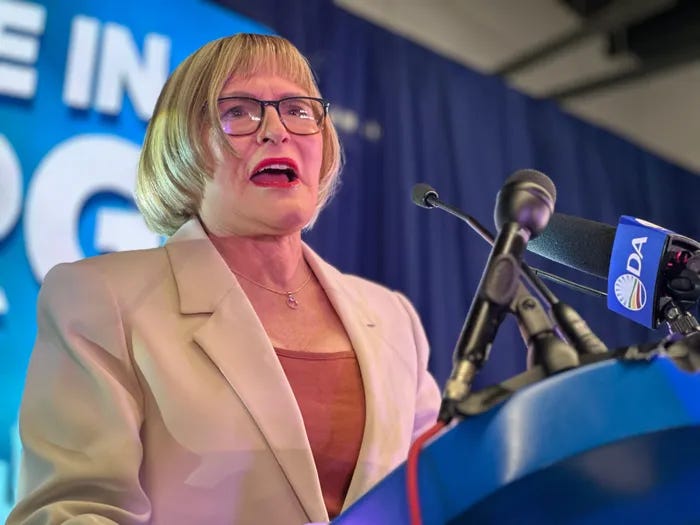
Helen Zille’s announcement for Joburg mayor has sparked much response, caused much controversy, and mobilised what will be a long race to 2026. The thought that seems to not be explored: could it be that Helen Zille may be a uniting force for all other political parties?
It almost goes without saying — Helen Zille brings both experience and controversy to the mayoral race in Johannesburg. With an already stellar governance CV in Cape Town and the Western Cape, in addition to being leader of the Democratic Alliance, Helen Zille has mounted herself as the opposition to the ANC and a crucial force in South Africa. But not absent of controversy.
Being known to make statements about the “benefits” of colonialism, a strong voice in the anti-transformation conversation in South Africa, accompanied with an anti-progressive stance on Palestine that refuses to recognise the current ongoing genocide committed at the hands of Israel, does not make Zille the most popular candidate in the eyes of many voters.
The Zille campaign is already facing some difficulties after a recent interview with Anele Mdoda highlighted the imperfections in Zille — the inability and her unwillingness to accept that DA governance in the Western Cape has not been perfect. Furthermore, focusing on the white saviour narrative that may come to surround Zille’s campaign. Zille was unable to win over Anele and produced much of a reaction on social media.
Highlighting the first concern with Zille’s campaign: that she might be her own enemy. She may not be able to stay away from her all-too-well-known stances that do not sit well with the majority, and she may provide much debate on whether she is the right leader for Johannesburg.
However, this does not invalidate the unique situation Johannesburg is currently facing. Many journalists and some politicians claim that Johannesburg’s middle class is in dire need of a solution — a breath of fresh air. Zille represents someone who focuses strongly on her constituency and governs well for those who make up the middle and upper class, providing her a unique selling point outside of her politics.
The reality is that Johannesburg’s infrastructure has become ineffective to live a sustainable life. With some turning to go off-grid for those who have the resources, while the majority are faced daily with the challenges of dysfunctional infrastructure. Any change may be good.
The ANC, who have held dominant positions in Joburg pre-2016 and currently hold the mayorship, have been unable to turn around a situation that is self-inflicted. The narrative around Johannesburg has been closely aligned with the simultaneous decline of the ANC. Zille is primed to spark new interest and noise in a city that has seemed inactive and unstable for years.
Looking more closely at the election campaign itself, it will be hard for Zille and the city as a whole to escape what has been an ongoing fight between transformation and capital in South Africa. Already, Herman Mashaba, the leader of ActionSA, has called this a “dangerous perception that black people cannot lead,” suggesting Zille’s mayorship is potentially anti-progressive.
This sentiment — one that calls this an end to “black leadership” and a failure of the democratic project — will be a narrative that, if it gains legs, may mobilise the citizens of Johannesburg to respond and show up to the polls to keep “black leadership” in power.
If this is the case, it will highlight a weakness in South African politics. Not in the fact that Zille ought not be recognised in her race, but rather that South Africa is unable to progress from race politics and engage the discourse from a stance of policy. Even then, there are still many things Zille and the DA’s stance have not been well received on.
The EFF Head of International Relations, Nqobile Mhlongo, took to the media after Zille refused to recognise genocide in Gaza, and called out the DA:
“The DA has no regard for human life. During the 6th Parliament on the motion to cut diplomatic ties with Israel, they voted against the motion. The DA leader John Steenhuisen has on many occasions supported the genocidal Israel over their actions in the occupied Palestine.”
An interesting catalyst and uniting force for the other political parties — further indicating a party opposing the DA and the proposed mayorship of Helen Zille.
Assuming the trend is one where more parties become opposed to Zille, the stance her party takes, and what she will represent for “black leadership,” there is a reality where the parties come together to save face.
This would not seem out of the ordinary. Already in the formation of the provincial government of national unity, the DA was kept out by Premier of Gauteng Panyaza Lesufi due to back-and-forth regarding ministerial positions. Some believe it held more political implications — there was clear unwillingness to participate with the DA.
Similarly, in the back end of 2024, Cilliers Brink, former mayor of Tshwane who had the backing of Helen Zille, was voted out by the ANC in a vote of no confidence supported by ActionSA. Once again indicating a lack of willingness to work with the DA, but also the inability for there to be a coalition where the DA leads that lasts for extended periods of time.
Highlighting another major concern for Zille: that even though she may be able to garner the support to win Johannesburg, she may not have very strong coalition partners — and though they may be willing, they have been known not to deal well with DA leadership and their unwillingness to consider all the coalition partners’ concerns, as highlighted by both President Ramaphosa in recent interviews on News24 and Herman Mashaba. Indicating potentially a very volatile space for Zille.
Potentially giving way to the nightmare of the doomsday coalition in Johannesburg. Though the EFF, MKP and the ANC tend to have members from the same constituency, it will be an intense task if they collectively give way to an unprogressive leader — whom they have all had their respective scuffles with the DA. Defeat in the election will be one thing, but losing Johannesburg will be another.
However, only time will tell. Zille has a long trail ahead of her — one that will also have to deal with much change. The GNU takes both a mid-term budget and another budget cycle before the local government elections. If political memory is anything to go on, the country will be in for another battleground between the ANC and DA. Furthermore, Zille’s own party heads into a party election in April 2026 — further placing many question marks on what the future will hold.
Zille’s mayorship will be a major question for South African politics as a whole. It may give birth to new governance, a new way of politics — or it may be the exact same: endless debates and finger-pointing without a clear solution. Whatever the result, all that Johannesburg needs is governance that is for everyone, and not for the select few.
Johannesburg will watch Gog’ Zille as she attempts to claim the hearts, votes, and minds of millions in Johannesburg. The question is: will she do just that, or give birth to much different politics — a left-leaning politics?