

A struggling artisan with discomfort in his hands continues to toil with his tools. Refusing to sever his hands because his creations are necessary for his survival.
To say the flocks of young people leaving religion is a newfound occurrence would be wrong. People like Biko spoke to the trend of youths falling at odds with the church; however, now the widely traveled journey of deconstruction feels different, packaged with a newfound intellectualism and vibrance. For many, it is the net outcome of relief and release from bondage; freed from the attachment of their actions to eternal damnation in purgatory and the resolve of their crushing internal conflict. For me, the journey of religious deconstruction is not esteemed in relief or intellectual satisfaction. It is the abrupt removal of comfort and community. The divine explanation that my suffering is temporary or a part of a grand plan is gone. An omnipotent, benevolent creator deciding my future is now suddenly non-existent. Painstakingly, I know the reality my heart cannot accept, and neither can my family.
My mother calls every week and asks if I’ve found a youth group to join or if I’ve found a church to attend, and every time I tell her that I haven’t, she sighs in disappointment. She is weary for her son’s well-being, thinking it is likely to deteriorate without God or concern that the Lord will punish him. My grandmother’s happiest memory, as she so often proclaims, is my baptism. I cannot bring myself to tell them I’m agnostic. Even revealing the truth that I’m not religious to my peers is difficult; people on TikTok have referenced the need to “soft launch” the fact, wrapping it up in conversational foreplay before feeling comfortable enough to speak their truth. I can imagine the dull, repetitive and jarring debate that would likely ensue- the arguments I’ve heard a million times or have already picked apart in my head. Beyond my anxiety in “agnostically coming out,” it feels as if once I have shared my views, they’re final, and for some reason, I hope they aren’t because my mother’s eyes light up every Sunday, Easter, and Christmas, and even in my deconstruction phase, I crave her joy.
I yearn for the rhythm of church drums and incense. I feel incomplete without the Sunday routine of long church service. Part and parcel of the Black experience seems to be religious; so many individuals are compelled to seek intangible support from their precarious conditions. Now I stand alienated in navigating uncertainty for the first time in my life. What makes it marginally worse is the illogical fear that perhaps I’m wrong in my deconstruction and some divine ramification of failure awaits me. Stuck in this quagmire, I find myself more often than not reverting to what I’ve been taught as a child.
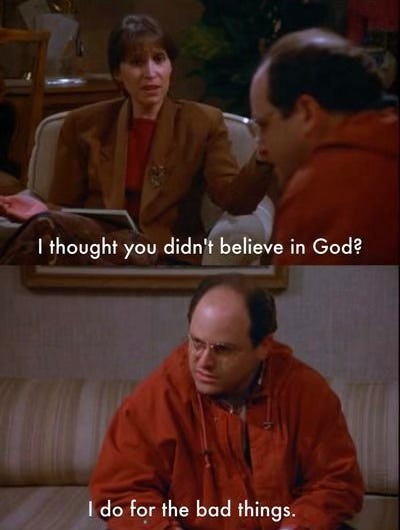
As if my eyes wide open, I close them. As if all the inertia pushing me to stand, I kneel; knowingly wrong, I close my eyes and pray. I pray for love, peace, and the health of my family and friends. Even selfishly to assume the intense suffering in the world would remain while mine is reduced, but what alternative do I have? Positioned to deal with pain and the weight of things I have little control over, what choice is there but to look above and plead?
I engage with religion in a quasi-genuine manner, drawing reliance through the escapism it offers but never having a tangible belief in its truth . Sigmund Freud argued, “religion is a system of wishful illusions”.Cognisant of the illusion, I choose to partially remain.
Like the artisan , I struggle with discomfort in my mind and heart, continuing to toil with the problem, refusing to sever it because its creations are paramount to my survival.
