

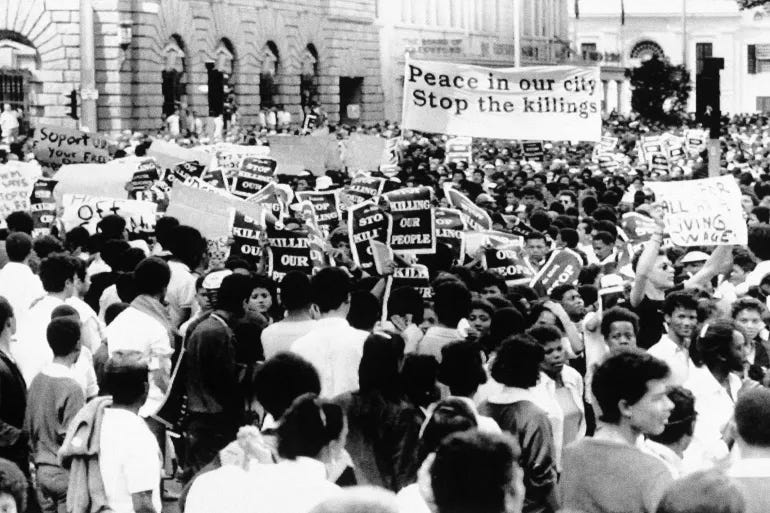
Activism, and specifically youth activism, feels as though it is seen as an end in the 21st century rather than a means to an end. The endless usurping of stages and moments to amplify the cause, while still being credited as an individual, has moved activism far from the collective and exposed the more selfish and perverse elements that once were the by-products of achieving the aims that activism intended to cause.
Recently, speaking to friends and hearing how they endlessly and sporadically move to the social cause of the time, declare their enemies and allies, and claim to be entirely, one hundred percent for the cause, there is almost no recognition of the previous cause. Whether it is Palestine–Israel, Russia and Ukraine, Sudan, the Congo, or more recently Venezuela and Iran, there seems to be no principles guiding the conversation. There is an emphasis on what is right without full understanding or justification for why it is true.
Due to the nature of social media and its capacity to create niched viewpoints adjusted to maximise engagement, there are both positive and negative sentiments that reinforce viewpoints and silo the world from the breadth, depth, and nuance that are required to understand the situations unfolding.
In the majority of instances, there is disagreement over history and perceived misunderstanding that continues to revitalise hostilities between states. Particularly with Russia, Ukraine, and Israel–Palestine, both sides’ motivations are rooted in their perception of history. On both sides, there have been atrocities — not equal to one another — but they stem from decades, sometimes centuries, that provide the context to understand the outbursts we see now.
Furthermore, with that being said, the solutions are probably far harder to reach than sentiments shared openly, such as two-state solutions or the return of usurped land in the case of Russia. There is both pride and fear of the impacts of defeat that all nations uphold, and sometimes, in the worst cases such as Palestine, there is no easier solution than destruction. This provides providence to go about the destruction of people in Gaza and wage physical, psychological, and mental torment until people have no option but to surrender.
However, I hope, at least, that the world will not watch the destruction of another state, nor do I believe in any instance that civilians should be used as casualties of war — one that they themselves did not consent to or willingly participate in. I hope for peace in Gaza and the world.
Conversely, more current issues, such as Iran and the capturing of Venezuelan President Maduro, raise an internal moral question: are democratic countries allowed to topple autocratic regimes they do not agree with? International law protects the sovereignty of all states, and there is evident history of collapsing governments that lead to worse outcomes, as seen in the Congo and Sudan. The people are left without a clear way out of governments they collectively distrust, and power has sporadically disappeared amongst a few controlling forces. Violence becomes a norm in these societies as territory is contested.
However, there is no negating their oppressive forms of governance — the killing of civilians, the use of the military against the public during protests, the arrest of women for refusing to wear hijabs in public. These governments remain far from perfect, and internal sentiment continues to be contested as the public protests and calls for the end of oppressive rule.
Somewhere lies the paradoxical nature of societies. They can be far from perfect — in some instances more than imperfect — and as people who experience the freedoms guaranteed through democracy, there is an aspirational belief to spread them around the world. Simultaneously, there can never be acceptance of instances where power alone defines the approach to geopolitics, or there will be no respect for diplomacy, governance, and international sovereignty. This would destroy much of what the world has worked to build, even if through imperfect systems.
Within this chaos — a whirlwind of events that has defined much of the 2020s — it is how this information is communicated to the people who champion the cause that defines our approach to these events. Whether it be celebrities, activists, or musicians, there is evident support for causes without any follow-through on what to do long-term. There is a lack of commitment and a culture of moving on when the act of activism does not pan out as successfully as deemed.
There is almost a newfound ability to be activists outside of communities, from screens, and never have to engage with the work, importance, and value of mobilising communities to actively direct action in a manner that leads to legitimate and intended outcomes. Much of the activism of today is to highlight a moment and move on, not to ensure systems are put in place and policies are advocated for that reduce the problem.
Moreover, there is immense pressure to be current, relevant, and knowledgeable about every issue. Though it is possible, it takes time. It requires more than reading brief summaries and gathering general facts. Additionally, it requires the humility to recognise that there are likely far more knowledgeable individuals who can speak to the issues being discussed at present.
A friend said to me at a protest about Palestine that none of the Palestinians were provided the opportunity to speak about their country, to provide their perspective, and to share how their pain may be different from ours. It was dominated by organisers and individuals who wanted to be seen as speaking to an issue rather than providing a platform for those who have survived the situation, or relate to it directly, to be empowered to tell their reality.
Additionally, in that same vein, understanding which solutions are viable only makes sense when they come from those most affected. In most instances, they are most attuned to their most pressing needs, which people they are most likely to trust and cooperate with, and most importantly, what is right for co-existence. Absent their input, it is nothing but another imposing voice declaring a solution without a clear or vested interest in success.
During the wave of liberation, they proclaimed, “African solutions for African problems.” It is about time that the same principle is applied across the world — where people find solutions, find dialogue, and seek a way forward collectively. For all of us to collectively remember, it will be far from easy and far from quick.
Social media activism has forced us to believe that things happen overnight — that saying something today will push society to be different tomorrow. However, it is far from that. Society does not change unless there is active will to teach how to change, to show what the other side — the better society — actually looks like, and to understand that the process is both collaborative and necessary.
Activism is also not linear. You fail more times than you succeed. There is no timeline for when change comes about. Moreover, there are too many issues to know all of them and be deeply invested in each. There is only so much time and energy every human has to give. It is okay not to know everything — there should simply be a willingness to learn and to have an informed outlook on the situation.
The world is dominated by applications that seek attention, and activism has become one of the roles in society competing for that attention. Let it not be another label assigned to people who engage in unpacking current affairs; let it be about people who are mobilising communities on the ground to be better. It requires more than likes, followers, and views — it requires people.
It is time that society as a whole learns about the world’s problems not only through a phone, but through its people. This is a country where everyone lives together and must therefore be active together in building the future, in declaring a better society.
Activism is meant to have aims, goals, policies, manifestos, and agendas. It is meant to speak to the people, find its voice in the people, and always be about the people. If there is truly to be activism, let it not be a moment, but a movement — with feet, voices, and chants — that pushes South Africa closer to a dream not merely manifested, but actualised.