

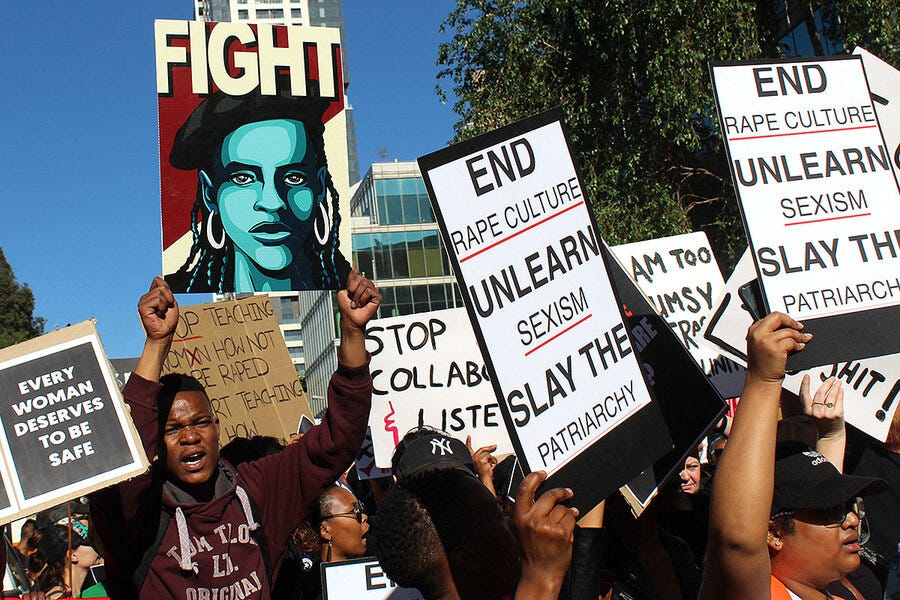
The saddening thing that was most apparent, seeing the count of women’s bodies being found that were left discarded, violated and uncared for, is that if you had woken up in 2019, the story would have been no different. The government was the source of the failure, the people the embodiment of anger, pain and refusing to accept the fate of injustice—and then nothing, silence, until the cycle continues. In order to do better, little has come to be done, maybe for a plight of reasons embedded in the history of the ruling party.
It is extremely important to state that South Africa has had a president who himself has been involved in the controversy of gender-based violence. Though acquitted and innocent in the eyes of the law, there is no denying the statistics of low prosecution and horrible collection of evidence. More importantly: using political capital to create torment for the victim:
“Fezekile Ntsukela Kuzwayo, known to the South African public only as Khwezi to protect her identity, made headlines when she alleged that Jacob Zuma had raped her in 2005 while he was the ANC deputy president.
Kuzwayo, an AIDS activist who was HIV-positive, was the daughter of an ANC member who had spent 10 years on Robben Island with Zuma, who had become a close family friend.
Zuma was acquitted on the rape charge in 2006, after claiming the sex had been consensual. In the aftermath, Kuzwayo and her mother were offered asylum in Holland after their home was burnt down and Kuzwayo received threats to ‘burn the bitch’.
Zuma, having been found not guilty of rape and corruption charges, became the president of South Africa in 2007.”
There was no attempt to protect her, there was no attempt to change the culture, and nor was there investment of resources to ensure the protection and safety of women from gender-based violence. Rather, it led to further victimisation and further violence—the common story when women choose to speak out about a culture synonymous with communities across the country.
During the case, when it was still very unclear as to who was seen innocent in the eyes of the law: “Posters waved by his supporters read ‘Jacob Zuma for President’ and ‘Jacob Zuma is the Best’. Loudspeakers mounted on a lorry pumped out a pro-Zuma pop song. Riot police stood by the demonstration and streets around the courthouse were closed.” There were very few people who seemed to be detracted by the action or the seriousness of the case to begin with. So it becomes easily recognisable how conversations about gender-based violence do not resonate with the people who are in government, because they have been seen to have been part of the problem.
The issue with enforcing the death penalty is that they open up themselves to the potentiality of their own death.
The reality is that their actions do not only stem from the new dispensation, but rather from before that. In a time where, even on Umkhonto we Sizwe camps, there was known abuse and torture of women. It has been a rot embedded deep within the party.
In testimony at the TRC, Teddy Williams shared what was known at one of the Angolan camps:
“Sexual abuse of young female recruits and the wives of soldiers was widespread in at least one African National Congress training camp in Angola, a Umkhonto we Sizwe commander told the Truth and Reconciliation Commission on Tuesday.
Teddy Williams, also known as Wellington Sejake, told the commission’s hearings in Umtata that he had been sent to Quibaxe camp in Angola in 1978 as a commander, after receiving military training in the former Soviet Union.
There he witnessed officers ‘helping themselves’ to women recruits.
‘These young girls were abused by the officers, mostly the administrators. They used to call them to administration and then do what they wanted.
Some of the trainees came with their girlfriends and wives. Even those wives were abused.’”
It was not a culture that happened in silence, but one that was known. One that this country has not come to reconcile with. Failed to recognise much, because the same victor of history and leaders of liberation molded the story to do away with the misgiving, indignity and abhorrent inhumane treatment they normalised. The silence placed on history continues to bleed into our modern lexicon:
“Despite these admissions, women were still reluctant to testify at the TRC. When current ANC deputy secretary general Jessie Duarte came before the TRC, she said that women were silenced by the liberation movement itself during the anti-apartheid struggle and that other women activists were complicit.
‘If women said that they were raped, they were regarded as having sold out to the system in one way or another,’ Duarte said.”
It takes off to the moment, the nightmare, the cycle that has become the South African government—more specifically, until recently, the ANC government—responding to the crisis. In 2019, with #NotInMyName, #AmINext and #SAShutDown, South Africa was grappling with the loss of Uyinene. The country was boiling to anger. The streets were filled. The President, Cyril Ramaphosa, responded to the crowd gathered outside and said: “Enough is enough and we are going to act… Men that kill and rape must stay in jail for life. The law must change that: once you have raped and kill, you get life, no bail.” Nothing happened. The problem persisted. The government failed. And the protest continued.
Then it was the G20 Shutdown. The country, and even parts of the globe, went purple in solidarity with the plight of women in South Africa. People wore all black. The country took to the streets, demanding the GBVF be deemed a National Disaster—a clearly outlined goal.
At the social summit for the G20, that goal was achieved. But the same man who failed in 2019 was due to progress. But until the story concluded, as it has many other times before: with failure, silence and tension building for the people to be embodiment of anger, pain and refusing to accept the fate of injustice—and then nothing, silence, until the cycle continues.
At this moment, we are currently faced with 9 women’s bodies having been discovered in Ekurhuleni. It highlights the failure, the problem and the root once again. But it also asks of everyone: what will be done differently? Where to go from here? And how does the country even begin to envision a safe world? Where do they find hope?
What this cycle does represent is—that hope. The fact that people refuse to give up and refuse to accept the status quo: that they too believe in a better place, a functional place and a safe space. It is now upon us to look at each other and ask: how do we do this without the government? Their failure should not be our failure.
More so: how does anger become a mechanism that charts us to breaking the cycle and setting the first steps forward for where we can denounce the cycle to that of history? Being a victim is not the norm.
Maybe it needs the silence to be broken—not just now, but in our past—if there is any hope in understanding who has women’s future at heart.
REST IN PEACE TO ALL THE WOMEN, KNOWN AND UNKNOWN.